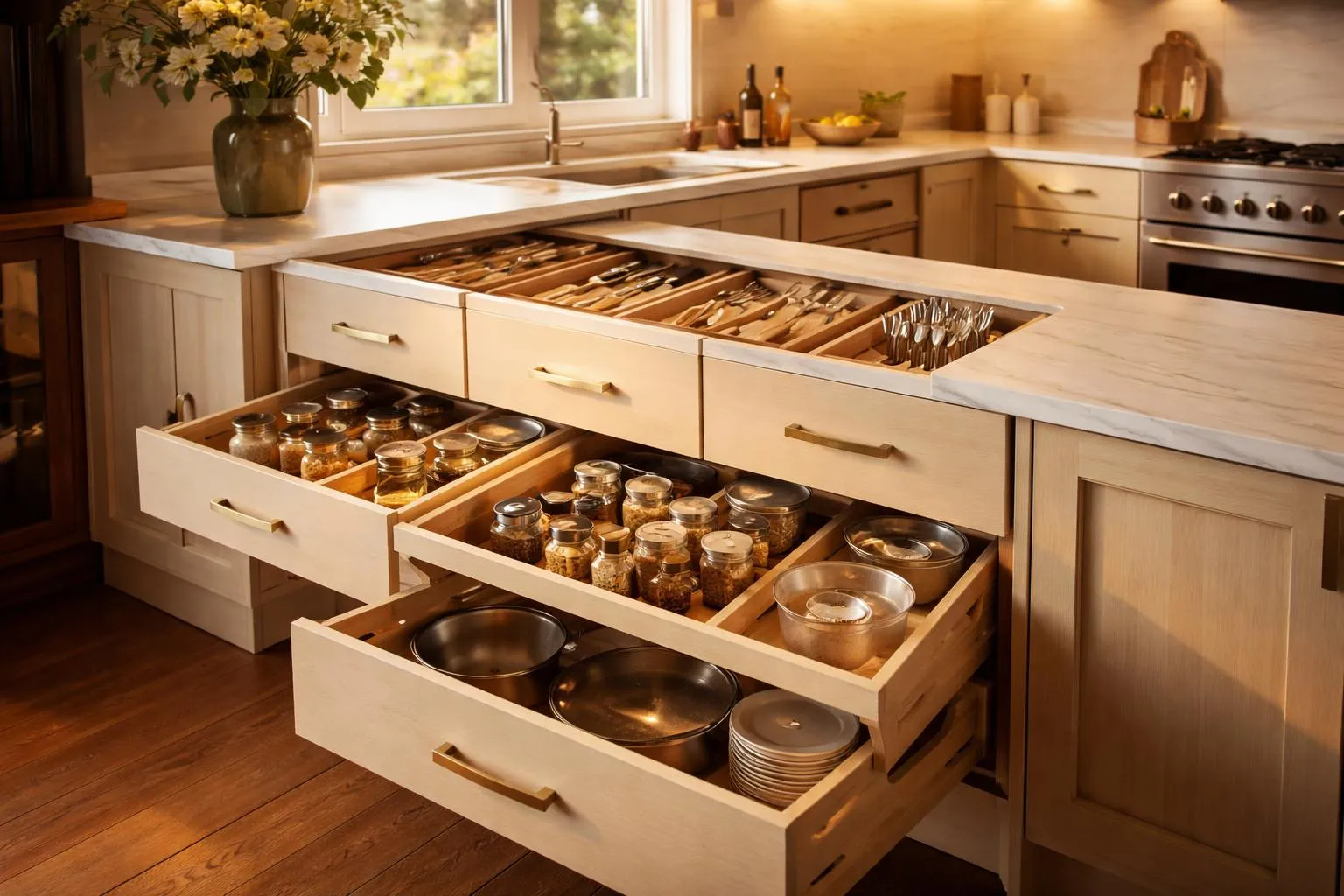
The kitchen gets judged by its finishes, but lived in by its storage.
That difference matters.
A beautiful room can still be annoying to use if the drawers are shallow, the corner cabinet is wasted space, or the shelves force you to stack plates like a balancing act. Cabinets do much more than fill a wall. They shape how you cook, clean, organize, and move through the room. They also affect how the space feels, especially in new construction and renovation projects where every inch counts.
Ready-made cabinets have their place. They are fast to source, easier to price, and sometimes good enough for straightforward layouts. But “good enough” is usually where the trade-off begins. Standard cabinet sizes work well in standard rooms. Real kitchens are rarely that cooperative. Walls are a little off. Corners are awkward. Appliances vary. Storage needs are personal. One household wants deep drawers for cookware. Another needs space for bulk food, serving platters, or small appliances that never seem to fit anywhere.
That is where custom cabinetry pulls ahead.
If you are weighing custom work against stock options, here are five benefits that make the difference hard to ignore.
Before getting into the advantages of custom work, it helps to be honest about the weakness of ready-made cabinets. They are built around standard dimensions and repeatable production. That keeps costs down. It also means the room has to adapt to the cabinet, not the other way around.
In a perfectly square kitchen, that can be fine. In a compact condo, an older home, an open-concept remodel, or a new build with specific appliance plans, it often creates filler strips, dead corners, odd gaps, and storage you never use well.
I’ve seen kitchens where six inches were lost at the end of a run because the cabinet size didn’t land cleanly. Six inches sounds minor until you realize it could have been a pull-out pantry, tray storage, or wider drawers for pots and pans. Stock systems leave those little losses all over the room. Over time, they add up.
Custom cabinets start from the actual space and the way the space is used. That changes everything.
This is the most obvious advantage, and probably the most important.
Custom cabinets are built to exact measurements. That means they can account for uneven walls, unusual ceiling heights, tight corners, structural obstacles, and appliance layouts that do not follow standard assumptions. Instead of forcing a room into preset boxes, a cabinet maker can shape the cabinetry around the reality of the room.
In practical terms, that leads to better use of space. In many layouts, custom cabinetry can increase usable storage by up to 40 percent compared with stock alternatives. That number is especially believable in kitchens where standard sizing creates empty filler areas or unusable corners.
A few common examples make the point:
A narrow galley kitchen where every extra inch of drawer width matters
An older home with walls that are not perfectly plumb
An open-concept kitchen that needs cabinetry to look clean from multiple sightlines
A compact suite where upper cabinets need to reach closer to the ceiling
A new construction project with specific appliance, island, and counter top plans
This is not only about squeezing in more cabinets. It is about making the room feel intentional. When cabinets fit cleanly, the kitchen looks calmer. The lines make sense. The storage feels built into the architecture instead of dropped into it.
And if you are planning a custom counter top, the case for precision gets even stronger. Cabinet dimensions affect overhangs, appliance clearances, sink placement, and the way the counter top meets walls and backsplashes. Better cabinet fit usually leads to a cleaner installation across the whole kitchen.
This part is less exciting than door styles and paint colors, but it is where custom cabinets often justify their price.
Ready-made cabinets are commonly built for speed and broad affordability. That usually means more engineered materials, lighter construction, lower-grade hardware, and finishes that may not age well in high-use areas. There are decent stock products on the market, of course, but many are still designed around cost control first.
Custom cabinetry tends to use better materials and more deliberate construction. Think solid woods where appropriate, stronger joinery, thicker cabinet boxes, better drawer slides, and hinges that feel solid after years of use, not just on installation day.
The lifespan difference can be significant. Many ready-made cabinets hold up for about 5 to 10 years before wear becomes hard to ignore. A well-built custom set can last 20 years or more with proper care. That changes the math.
At first glance, stock cabinets look cheaper. Over a longer period, the picture gets murkier. If lower-grade cabinets need repairs, refinishing, hardware replacement, or full replacement years earlier, the savings start to evaporate. You also have to live with the daily friction of drawers that stick, doors that sag, shelves that bow, and finishes that chip in high-touch areas.
Better craftsmanship usually means less maintenance too. That matters in busy kitchens where moisture, grease, heat, and constant opening and closing test every surface. When the construction is solid from the start, you spend less time babysitting the cabinets later.
This is the benefit people often appreciate most after move-in.
Stock cabinets are designed around general use. They assume a typical mix of shelves and doors will work for most people. Sometimes it does. Often it does not. A baker, a large family, a serious home cook, or a business outfitting a breakroom or hospitality kitchen may all use the space in completely different ways.
Custom storage lets the cabinet design follow your habits instead of forcing your habits to adapt.
That can include:
Pull-out spice racks beside the range
Deep drawers for pots, pans, and mixing bowls
Vertical dividers for baking trays and cutting boards
Appliance garages for mixers, blenders, or coffee equipment
Drawer inserts for utensils and knives
Recycling and waste pull-outs
Corner solutions that make awkward areas useful
Pantry sections sized for bulk storage
These choices are not cosmetic upgrades. They change how the kitchen functions every day. A well-planned custom layout can reduce visible clutter by around 50 percent because more items have a proper home. Counters stay clearer. Cabinets are easier to keep organized. Cooking feels less like a search mission.
I think this is where custom work feels most human. Good cabinetry should reflect how people actually live. If someone uses a rice cooker every day, why hide it in the back of a base cabinet? If a household buys groceries in bulk, why pretend a few shallow shelves will handle that? If the family uses oversized platters twice a month, they still need a place to go.
A skilled cabinet maker will ask those kinds of questions early. That is one reason custom planning often leads to fewer regrets later.
Ready-made cabinets usually offer limited door styles, finishes, sizes, and trim details. That keeps manufacturing simple. It can also make different kitchens look suspiciously alike.
Custom cabinetry opens up far more choice. You can select wood species such as oak, maple, cherry, or walnut. You can choose painted finishes, stains, sheen levels, door profiles, panel details, edge treatments, glass inserts, hardware, trim, and decorative features that fit the character of the space.
That matters whether your taste leans modern, traditional, transitional, or somewhere in between. It also matters if the kitchen needs to relate to the rest of the building. A sleek new build may call for flat-panel doors and minimal hardware. A character home renovation might need warmer wood tones and more detailed fronts. A commercial or multi-unit project may need a durable, consistent look across several spaces without feeling cheap.
Good cabinet design also helps cabinetry work with the counter top instead of fighting it. This pairing gets overlooked. Door style, finish color, cabinet depth, and edge detail all influence how stone, quartz, laminate, or wood surfaces read in the room. If the cabinets are generic, the counter top sometimes has to do all the visual work. When both are planned together, the room feels more balanced.
There is another advantage here that people do not always expect: proportion. Custom cabinets can be sized so the kitchen looks right. That sounds obvious, but standard cabinets can create strange reveals, mismatched heights, or awkward gaps above upper cabinets. Custom proportions fix that. The room feels less like a collection of components and more like one cohesive design.
Plenty of home upgrades are personal and hard to recover financially. Kitchens are different. Buyers pay attention to them, and they notice cabinetry fast.
Custom cabinets tend to help resale for two reasons. First, they look more integrated and better maintained over time. Second, they improve function in ways buyers can understand immediately. Deep drawers, thoughtful pantry storage, clean built-ins, and quality finishes are easy to appreciate during a showing.
Return on investment always depends on the market, the price point of the home, and the overall quality of the remodel. Still, kitchen projects with custom cabinetry are often estimated in the 70 to 80 percent ROI range. Homes with high-end, updated kitchens also tend to sell faster, in some cases around 30 percent faster than homes with outdated cabinetry.
Even if you are not planning to sell soon, resale still matters. Tastes change. Life changes. People relocate. A kitchen that holds up well and appeals to future buyers protects your options.
That said, I would not make the case for custom cabinets on resale alone. The stronger argument is that you get years of better daily use before any buyer ever sees the place. The return is financial, yes, but also practical. You enjoy the upgrade while you live with it.
This is the objection that comes up first, and fairly so.
Custom cabinets cost more upfront than ready-made options. There is no way around that. The design work is more involved, the materials are often better, and the fabrication takes time. If the budget is very tight and the layout is simple, stock cabinets may be the sensible choice.
But cost and value are not the same thing.
When you compare initial price tags only, stock usually wins. When you compare fit, storage efficiency, durability, maintenance, and lifespan, custom often looks stronger. Paying less for cabinets that waste space, wear out sooner, and never quite solve your storage problems is not always the cheaper decision in real life.
There is also a middle path. A hybrid approach can help control budget without giving up the best parts of custom work. For example, some projects use custom uppers with stock lowers, or custom pieces only where the layout is tricky, such as islands, pantries, or corner areas. This can be a smart move when you want targeted improvement rather than a fully custom package.
Stock cabinets are available quickly. That speed is part of their appeal. If you need something immediately, they are hard to beat.
Custom projects usually take around 6 to 8 weeks from design to completion, sometimes longer depending on scope, finish selection, and installation conditions. For a renovation or new construction schedule, that means planning ahead.
The extra time is not wasted time. It is where measurement, cabinet design, material selection, fabrication, finishing, and coordination happen. In my view, that is time better spent upfront than after installation trying to solve problems that should never have existed.
If you are in the early planning phase, this is the right moment to list your pain points. Be honest. What annoys you in the current kitchen? What gets stored on the counter because there is nowhere else for it? Which drawers are overstuffed? Which shelves are too high, too deep, or too awkward to use? Those answers are useful whether you choose full custom, a hybrid approach, or a more modest redesign.
A simple test helps.
Custom cabinets are usually worth serious consideration if one or more of these is true:
Your layout is unusual, compact, or full of wasted space.
You plan to stay in the property long enough to benefit from better durability.
You want storage designed around specific routines, tools, or appliances.
You care about matching the cabinetry to a particular architectural style.
You want the kitchen, cabinets, and counter top planned as one system rather than separate purchases.
If none of those apply, ready-made cabinets might be enough. But if several do, custom starts to look less like a luxury and more like a practical choice.
Cabinets set the tone of a kitchen, but more importantly, they set the rules for how the kitchen works.
Custom cabinetry gives you a better fit, longer life, smarter storage, more design freedom, and stronger long-term value than most ready-made alternatives. It asks for more money and more patience at the start. In return, it usually gives back more space, fewer frustrations, and a kitchen that feels made for the people who actually use it.
That last part matters most.
If you are planning a renovation or a new build, take a close look at the layout before choosing cabinets from a catalog. Measure the awkward corners. Notice the dead space. Write down what you need to store, what you want hidden, and what you want close at hand. Then compare those needs against standard sizes honestly.
That exercise alone often makes the decision clearer. Custom cabinets are not the right answer for every project. But when function, durability, and thoughtful design matter, they are very often the better one.

.png)


