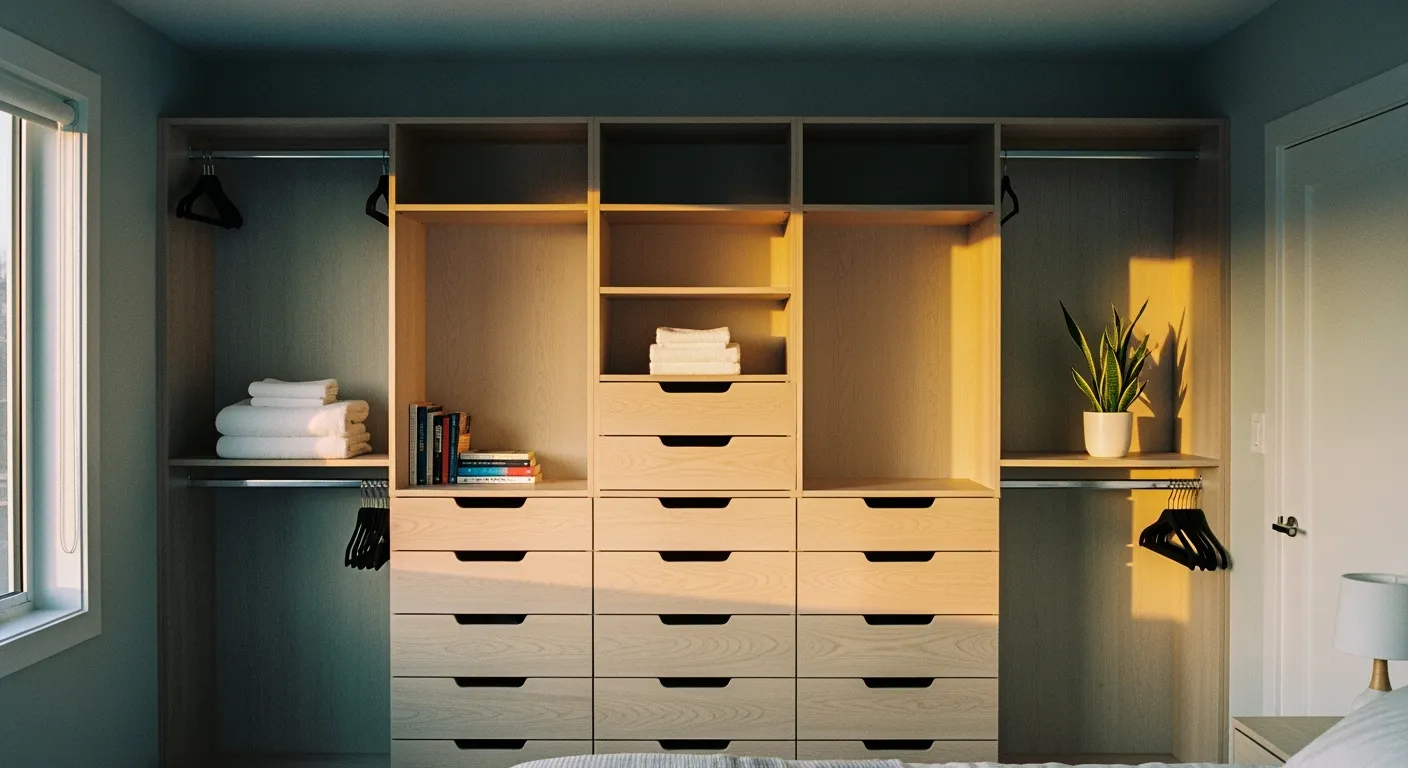
If you live in Vancouver, there’s a decent chance your closet is doing too much with too little.
A condo closet in Yaletown has to hold work clothes, rain gear, gym stuff, luggage, and maybe a vacuum because there’s nowhere else to put it. In a Kitsilano character home, the closet might be narrow, crooked, and built for a different century. In a newer South Surrey build, the closet may look clean on day one but still come with the same generic shelf-and-rod setup that wastes vertical space.
That’s why more homeowners are moving away from temporary storage fixes and toward built-in closet cabinets. The appeal is simple: custom storage uses the space you actually have, instead of asking you to live around the limits of a flat-pack system.
And honestly, that difference matters more than people think. A closet is a small part of a home, but when it works badly, you feel it every morning.
Most standard closets are built to a formula. One shelf up top. One hanging rod below. Maybe a second rod if someone tried to “maximize” the space. On paper, that sounds fine. In real life, it often leaves dead zones, cluttered floors, and piles that migrate into the bedroom.
Vancouver homes have some very specific storage problems.
In smaller condos, square footage is expensive, so every inch matters. You don’t have a spare room to hide the overflow. In older houses, walls may be out of square, ceiling heights may vary, and old framing can make off-the-shelf products fit badly. In newer homes, closets can be large but oddly laid out, which is its own problem. Size alone doesn’t guarantee function.
The issue usually isn’t that homeowners own too much stuff. Sometimes that’s part of it, sure. But more often, the closet layout is simply wrong for the way people live now.
A couple sharing one reach-in closet needs separate zones. A family needs room for seasonal coats and sports gear. Someone working hybrid may want part of a walk-in for folded office wear, bags, and document storage. The old rod-and-shelf setup doesn’t think that way.
Built-in closets are less about luxury and more about control.
Instead of adapting to a generic unit, the storage is shaped around the room, the wall conditions, and what you need to store. That means drawers where you actually need drawers, taller hanging sections for dresses or coats, shelves spaced for shoes that you really own, and upper cabinets that make use of height most people ignore.
This is where good cabinet design earns its keep. The goal isn’t to cram in as many compartments as possible. Too many tiny sections can be just as annoying as too few. The goal is to create a layout that feels easy to use every day.
A well-designed built-in closet usually solves a few core problems at once:
It uses the full height and width of the closet
It reduces visual clutter with drawers, doors, and defined zones
It fits around awkward corners, bulkheads, or uneven walls
It separates shared storage so two people aren’t fighting one rail
It gives small items a real home instead of letting them drift
That last point sounds minor, but it changes the whole room. When sunglasses, belts, chargers, handbags, and folded sweaters all have a place, the bedroom feels calmer too.
The before-and-after photos are fun, but the process is what makes the result work. A custom closet project usually moves through a few clear stages.
This is where a lot of flat-pack attempts go sideways.
Closets are rarely as clean and simple as they look. Baseboards steal depth. Doors swing into usable space. Walls lean. Ceiling drops show up where you didn’t notice them before. Condo sprinkler heads, attic access panels, and electrical boxes can all affect the layout.
Precise measuring matters because built-ins are supposed to feel intentional, not squeezed in. A professional cabinet maker will look beyond the basic width and height and note the details that affect installation. That includes clearances, trim, flooring transitions, and whether the wall is straight enough to accept full-height cabinetry without awkward gaps.
In older Vancouver homes, this step is especially important. A closet in Kitsilano might look standard until you measure both sides and realize they’re not the same depth.
This is the part homeowners often underestimate, and it’s probably the most useful.
A design consultation is where the closet stops being “a place for clothes” and becomes a set of storage decisions. What needs to hang? What should be folded? How many shoes need easy access? Do you want deep drawers or shallow ones? Are there items that only come out twice a year?
Good cabinet design starts with habits, not just dimensions.
For a Yaletown condo owner, the conversation might focus on making one closet handle daily clothing, outerwear, and household overflow. For a family in South Surrey, it may be about creating cleaner zones in a primary walk-in while using another cabinet system for kids’ rooms or entry storage. For a renovation in an older house, the design may need to work around strange framing or preserve character details without wasting space.
This stage is also where materials and finishes come in. Some people want the closet to disappear quietly into the room. Others want it to feel like furniture. Both are valid. The practical questions matter just as much: easy-clean finishes, durable drawer hardware, lighting access, and enough depth to handle the hangers you actually use.
Once the space and storage needs are clear, the layout takes shape.
This is where custom cabinets pull ahead of flat-pack systems. Off-the-shelf components come in fixed widths, fixed depths, and limited combinations. That can be fine in a perfectly square spare bedroom closet. It’s far less fine in a real Vancouver home with awkward geometry.
A custom layout can include full-height cabinets, double-hang sections, drawers, adjustable shelving, tilt-out hampers, overhead storage, and specialty compartments without forcing everything into preset modules. It can also leave intentional negative space where you need it, which is something people forget. Every wall does not need to be filled.
A good layout should feel balanced. You want enough open access to make daily use easy, and enough closed storage to cut down on visual mess.
Once the design is approved, the pieces are built to match the plan.
This is where consistency matters. Clean edges, durable finishes, solid hardware, and accurate sizing all affect how the closet holds up after a year of real use. Drawers should glide smoothly. Shelves should be supported properly. Panels should fit tightly enough that the final installation looks integrated, not assembled in a hurry.
People often think of a cabinet maker only in kitchen terms, but the same precision applies here. Closets may not have a sink or stove beside them, but they get daily wear. Cheap hardware gets annoying fast.
If the closet is part of a larger renovation, this is also when adjacent details may be coordinated. That might include matching other built-ins in the bedroom, tying the finish to nearby millwork, or planning around a dressing area vanity with a counter top surface if the room includes one.
Installation day is where the room finally changes.
The old wire racks or basic shelves come out. The new system goes in piece by piece, then gets secured, aligned, adjusted, and finished cleanly against the walls. In a good install, the result looks built for the room because it was.
That’s the part homeowners notice immediately. The closet suddenly looks calmer. There’s less exposed clutter. The floor opens up. Dead air above the top shelf becomes useful storage. The random pile of “I’ll deal with this later” items disappears into drawers or upper cabinets.
It isn’t magic. It just feels like it because the room finally makes sense.
Flat-pack storage has its place. If you need a quick, low-cost fix for a rental or temporary room, it can help. I wouldn’t pretend otherwise.
But for many Vancouver homeowners, it becomes a compromise that lingers for years.
The biggest issue is fit. Standard units leave gaps above, beside, or behind them. In a tight condo, those gaps are lost storage. In an older home, they can make the whole closet look unfinished. Flat-pack parts also tend to struggle with unusual dimensions, deeper storage needs, and spaces interrupted by bulkheads or sloped ceilings.
Then there’s durability. Closet systems get tugged, stuffed, and overloaded. Drawers open every day. Shelves take more weight than expected. A custom system built for the room generally handles that long-term use better than a lightweight modular setup that was never meant to be exact.
There’s also a visual difference. Built-in cabinets tend to feel like part of the home. Flat-pack systems often look like they arrived later and are trying their best.
That may not bother everyone. But if you’re renovating, building new, or investing in a home you plan to stay in, that distinction matters.
In a downtown condo, storage pressure is constant. Bedroom closets often have to absorb more than clothing because utility space is limited.
A custom setup here might include shallow drawers for smaller items, full-height upper cabinets for luggage, double-hang sections for workwear, and a single tall bay for coats or longer pieces. Mirrored doors can help visually lighten the room. Interior lighting can make a narrow closet easier to use.
The point is not to overbuild. In a compact space, restraint matters. Every component should earn its spot.
Older homes have charm. They also have closets that can be a little ridiculous.
You may get narrow openings, uneven plaster, old trim, and dimensions that ignore modern storage standards completely. This is where custom work makes a real difference, because the closet doesn’t need to be forced into a standard product size.
In these homes, cabinet design often has to respect what’s already there. You might keep original casing while improving the interior. You might build around quirks instead of trying to erase them. When done well, the result feels practical without making the house lose its personality.
Newer homes tend to offer more space, but “more space” and “better storage” are not the same thing.
A large walk-in with one shelf around the perimeter is still a missed opportunity. Homeowners often want a cleaner, more tailored layout after moving in and realizing the builder-grade closet doesn’t match how they use the room.
Here, built-in cabinets can add polish quickly. Matching finishes, integrated drawers, display-style shelving for bags or shoes, and better use of vertical space can turn a plain walk-in into something that works from day one instead of becoming a future project.
Before planning a closet renovation or adding built-ins to new construction, it helps to get honest about how the space is used now.
A few questions are worth asking:
What ends up on the floor, and why?
Which items are hardest to reach?
Do you need more hanging space, more drawers, or both?
Are two people sharing the closet with completely different routines?
Is the goal to store more, or to make the room feel less chaotic?
These answers shape the design more than trends do.
It’s also smart to think ahead a little. Kids grow. Work routines change. Seasonal clothing shifts. Adjustable shelves or flexible sections can keep a closet useful longer without needing a full redo.
If the project is part of a wider renovation, look at related surfaces and finishes too. Even though a closet usually doesn’t involve a counter top, an adjacent vanity, laundry zone, or bedroom built-in might. Coordinating those details early tends to create a more finished result overall.
The visual transformation matters, yes. But the bigger change is usually behavioral.
When a closet works, people maintain it with less effort. Laundry gets put away faster. Shared spaces cause fewer arguments. Mornings feel less frantic. You stop buying duplicate items because you can finally see what you own.
That’s the kind of improvement people notice a week later, not just on install day.
A cluttered closet often feels like a personal failure. It usually isn’t. More often, it’s a design failure. The storage never matched the home, the room, or the people using it.
Built-in closet cabinets don’t solve every organizing problem. They won’t make anyone love folding sweaters. But they do remove a lot of the friction that keeps a space messy.
For Vancouver homeowners, that’s a pretty practical upgrade. In a city where space is expensive and homes come with all kinds of quirks, using storage well is not some finishing touch. It’s part of making the home function properly.
And that, more than the polished photos, is why custom closets keep catching on.

.png)


