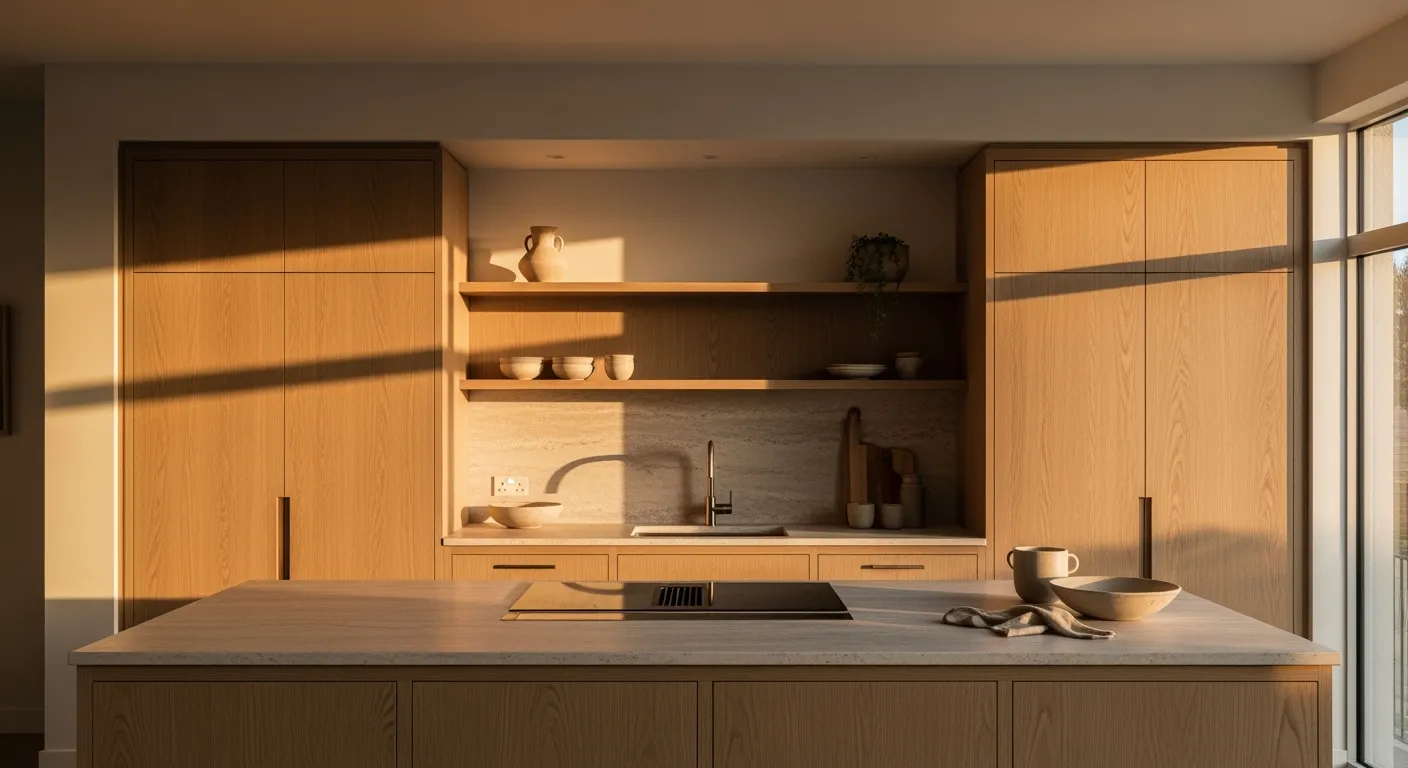
Walk into a truly well-made kitchen and you notice it before you can explain it. The drawers close with a soft, solid feel. The cabinet finish looks calm instead of shiny. The storage makes sense. Nothing is begging for attention, yet everything feels considered. That is the appeal of quiet luxury.
For quiet luxury kitchens 2026, the shift is pretty clear. People are moving away from flashy upgrades and short-lived trends. They want timeless kitchen design, durable materials, and layouts that work hard every day. In Vancouver, that instinct makes even more sense. Homes here range from compact condos to older character houses to new construction, and each one brings its own spacing, moisture, and storage challenges. Custom kitchen cabinets Vancouver homeowners and builders choose today need to look refined, but they also need to survive real life.
This is where custom cabinetry earns its keep. Good custom work is not about excess. It is about precision, better use of space, stronger materials, and a design that feels right for the home instead of forced into it.
Quiet luxury is easy to misunderstand. It does not mean plain. It does not mean expensive for the sake of it either. It means restraint paired with quality.
In kitchen design, that usually shows up through matte or low-sheen finishes, warm wood tones, muted painted colors, and subtle hardware choices. Think putty, greige, sage, charcoal, off-white, and natural oak instead of bright white lacquer and high-contrast trend combinations that date quickly. The look is softer. More grounded.
It is also sensory. You feel quiet luxury as much as you see it. The grain of white oak under a hand-finished clear coat. A heavy drawer front that does not wobble. A pull that feels solid rather than thin and decorative. Full-height doors with crisp lines. Precise gaps. Clean joins.
That level of restraint can be harder to get right than a dramatic design. Loud choices hide mistakes. Minimal kitchens do not. When the style depends on subtlety, craftsmanship matters more.
Stock cabinets work for some projects, but they come with limits. Standard widths, fixed depths, filler panels, awkward gaps, and a one-size-fits-all approach can waste valuable room, especially in Vancouver homes where layouts are often anything but standard.
Custom cabinets solve a few problems at once.
First, they fit the architecture. A cabinet maker can design around sloped ceilings, narrow galley kitchens, heritage details, structural columns, unusual appliance sizes, and open-plan layouts. That matters whether you are renovating a Kitsilano bungalow, finishing a downtown condo, or planning cabinetry for a new build.
Second, custom cabinet design uses every inch better. This is a big deal in Vancouver, where square footage is expensive and storage pressure is real. A well-planned custom kitchen can turn dead corners, shallow walls, and ceiling height into useful storage instead of lost space.
Third, custom work makes appliance integration easier. Built-in fridges, concealed range hoods, panel-ready dishwashers, microwave drawers, and coordinated counter top details all look better when they are planned together from the start.
That is why custom kitchen cabinets Vancouver property owners choose often outperform stock options in both function and finish. The kitchen feels calmer because it is less compromised.
Material choice does a lot of heavy lifting in a kitchen. It shapes the look, the lifespan, the maintenance routine, and the budget.
For a quiet luxury kitchen, a few cabinet materials stand out.
White oak, maple, and cherry remain strong choices because they age well and have a natural depth that painted surfaces sometimes lack. White oak is especially popular for good reason. It has a warm grain, suits modern and transitional homes, and pairs easily with stone or engineered counter top materials.
Solid wood is durable, but it also moves with humidity. That does not make it a bad choice. It just means fabrication and finishing need to be done properly. In many kitchens, plywood cabinet boxes with hardwood veneer fronts offer a smart balance between stability and appearance.
People still underestimate laminate. Good laminate is not the flimsy product many remember from decades ago. Modern high-performance laminates can look refined, resist wear well, and suit minimalist cabinet design beautifully. Matte laminates are especially effective in quiet luxury kitchens because they create a soft, low-glare finish.
For some projects, especially multi-unit builds or busy family homes, laminate makes practical sense. It can deliver a very clean look at a lower cost than solid wood.
Engineered products like moisture-resistant MDF and plywood play a major role in moisture-resistant cabinetry Vancouver homeowners need. Painted cabinet doors often use MDF because it provides a smooth, stable surface. Cabinet boxes commonly use plywood because it is structurally strong and handles kitchen conditions better than cheaper particleboard.
The point is not to chase one “best” material. It is to match the material to the use. Sink cabinets, island ends, and high-touch drawers need more durability than a decorative upper door.
Quiet luxury lives in details. A cabinet finish can look simple from across the room, then feel exceptional up close.
Low-sheen finishes are usually the right move. Matte and satin surfaces soften light and hide fingerprints better than very glossy ones. They also make color feel deeper and less synthetic. In Vancouver’s softer natural light, this matters. A muted finish often looks more settled and architectural than a bright reflective one.
Hardware should support the design, not hijack it. Integrated pulls, recessed channels, slim edge pulls, and restrained knobs all work well. If you want visible hardware, brushed brass, aged nickel, and matte black are common choices, but scale matters more than color. Oversized statement pulls can fight the whole point of quiet luxury.
Then there is the part people notice without naming: motion. Soft-close hinges and drawer slides are now expected in good cabinetry, but not all soft-close systems feel the same. Better hardware has smoother travel, less wobble, and more weight capacity. That is part of what separates decorative cabinetry from cabinetry built for daily use.
A beautiful kitchen that functions poorly gets old fast. This is why bespoke kitchen storage solutions are often the smartest investment in the whole room.
Custom cabinetry gives you options that stock layouts usually cannot.
Ceiling-height kitchen cabinets are one of the most useful examples. They reduce dust-catching gaps above upper cabinets and turn wasted vertical room into storage for seasonal serving pieces, less-used appliances, or pantry overflow. In homes with high ceilings, they also help the kitchen look properly scaled.
Pull-down shelving can make upper storage more accessible. Deep drawer bases often outperform lower-door cabinets because you can see contents from above instead of crouching and reaching into the dark. Corner cabinets, which are notorious for swallowing cookware, can be fitted with lazy Susans, swing-out shelves, or blind-corner pull-outs that make the space usable.
Inside the cabinets, small upgrades make a big difference. Think spice pull-outs beside the range, tray dividers, cutlery inserts, recycling centers, vertical slots for baking sheets, and drawer organizers sized to the way the household actually cooks. A serious home cook has different needs than a rental unit. A family kitchen has different needs than a staging kitchen in a new build. Good cabinet design respects that.
This is also where kitchen cabinets and counter top planning should meet. If the island will be a prep zone, the drawer storage, outlet placement, and counter top overhang all need to support that use. If a coffee station is being tucked into a wall of tall cabinets, the ventilation, lighting, and shelf depth need to be decided early.
Cabinet problems do not always show up on day one. Sometimes they appear after a wet winter, a ventilation issue, or years of steam collecting in the wrong place.
That is why climate-conscious detailing matters in this region. Moisture-resistant cabinetry Vancouver projects require is not just about picking a resistant board and calling it done. It is also about installation and airflow.
Areas around sinks, dishwashers, fridges with water lines, and poorly vented cooking zones need extra attention. Proper sealing of cut edges, durable finishes, and sensible material selection all help reduce swelling, peeling, and warping. Corrosion-resistant hardware is worth specifying too, particularly in homes close to the coast where damp air is part of the deal.
Ventilation is another point people ignore until there is trouble. Cabinetry should allow for airflow behind certain appliances where required. Range hoods need to be sized and installed correctly. Sink cabinets benefit from thoughtful detailing because even careful homeowners eventually get a leak or a spill.
This is not glamorous advice, but it is the sort that protects an investment. Quiet luxury falls apart quickly if the cabinet toe kick swells or a door edge starts lifting.
The budget for custom cabinets depends on material, door style, finish type, storage accessories, hardware quality, layout complexity, and installation conditions. There is no universal number, which frustrates people, but there are workable ranges.
Installed cost per linear foot often falls roughly here:
MDF: $175 to $300
Laminate: $200 to $350
Plywood with veneer: $250 to $400
Solid wood: $300 to $600
Those ranges can move higher with specialty finishes, complex millwork, interior organizers, integrated lighting, and premium hardware. They can also shift depending on whether the project is a simple run of base cabinets or a full kitchen with tall pantry walls, an island, appliance panels, and coordinated bathroom or utility cabinetry.
If you are trying to spend wisely, I would not put all the money into the most photogenic feature. Invest first in the cabinet boxes, hardware, layout, and high-use storage. That is the stuff you live with every day. Door style and color matter, of course, but a pretty kitchen with cheap drawer slides gets irritating fast.
Also, think beyond the sticker price. Durable materials, precise installation, and better organization often reduce future repair costs and delay the next renovation. That is where long-term value lives.
A good custom cabinet project usually follows a predictable path, even though each kitchen is different.
It starts with discovery. Measurements, photos, wish lists, pain points, appliance requirements, and style references all come into the conversation. This stage should cover practical questions, not just finishes. Who cooks here? How much pantry storage is needed? Is this for a family, a rental, or a multi-unit build? Will the counter top be natural stone, quartz, wood, or something else?
Then comes layout and cabinet design. This is where workflow, clearances, storage planning, and elevations are worked out. Many cabinet makers now use 3D renderings, and frankly, they are worth it. They help catch issues early and make subtle choices easier to compare, especially when deciding between painted and wood finishes or between visible and integrated hardware.
After design approval, production and installation are coordinated. Good communication matters here because cabinetry touches plumbing, electrical, flooring, appliance delivery, backsplash timing, and counter top templating. Delays often happen when these trades are not lined up.
The final walkthrough is not just a formality. Doors and drawer fronts should be checked, hardware adjusted, finish reviewed, and any touch-ups noted. Custom work deserves that last layer of attention.
Choosing a cabinet maker is partly about style, but mostly about trust and competence.
Look for someone who can explain materials clearly, not just show attractive samples. Ask how they build cabinet boxes, what hardware systems they use, how they deal with moisture-prone areas, and what happens if site conditions change during installation. Precision matters, and so does honesty.
Past work helps, but look closely at the right things. Are the reveals even? Do tall cabinets line up cleanly? Do the material transitions around the counter top and appliances look intentional? Fancy photography can hide mediocre joinery, so details matter.
Local experience helps too. A shop familiar with Vancouver homes is more likely to anticipate the odd framing, tighter footprints, older walls, and humidity concerns that show up in real projects.
If you are considering new cabinetry, whether for a renovation, a new build, or a commercial project, a free design quote is a sensible first step. Not because it locks you into anything, but because it gives shape to the project.
A useful quote conversation should help you assess layout options, compare materials, understand likely cost ranges, and decide where custom work will bring the most value. It should also clarify how the cabinets will relate to your counter top choices, appliance package, and installation timeline.
Quiet luxury is not about chasing what looks current in photos this year. It is about building a kitchen that still feels good after the novelty wears off. In Vancouver, that means careful cabinet design, climate-aware materials, and craftsmanship you can feel every time you open a drawer.
That kind of kitchen does not need to shout. It just needs to work beautifully.

.png)


