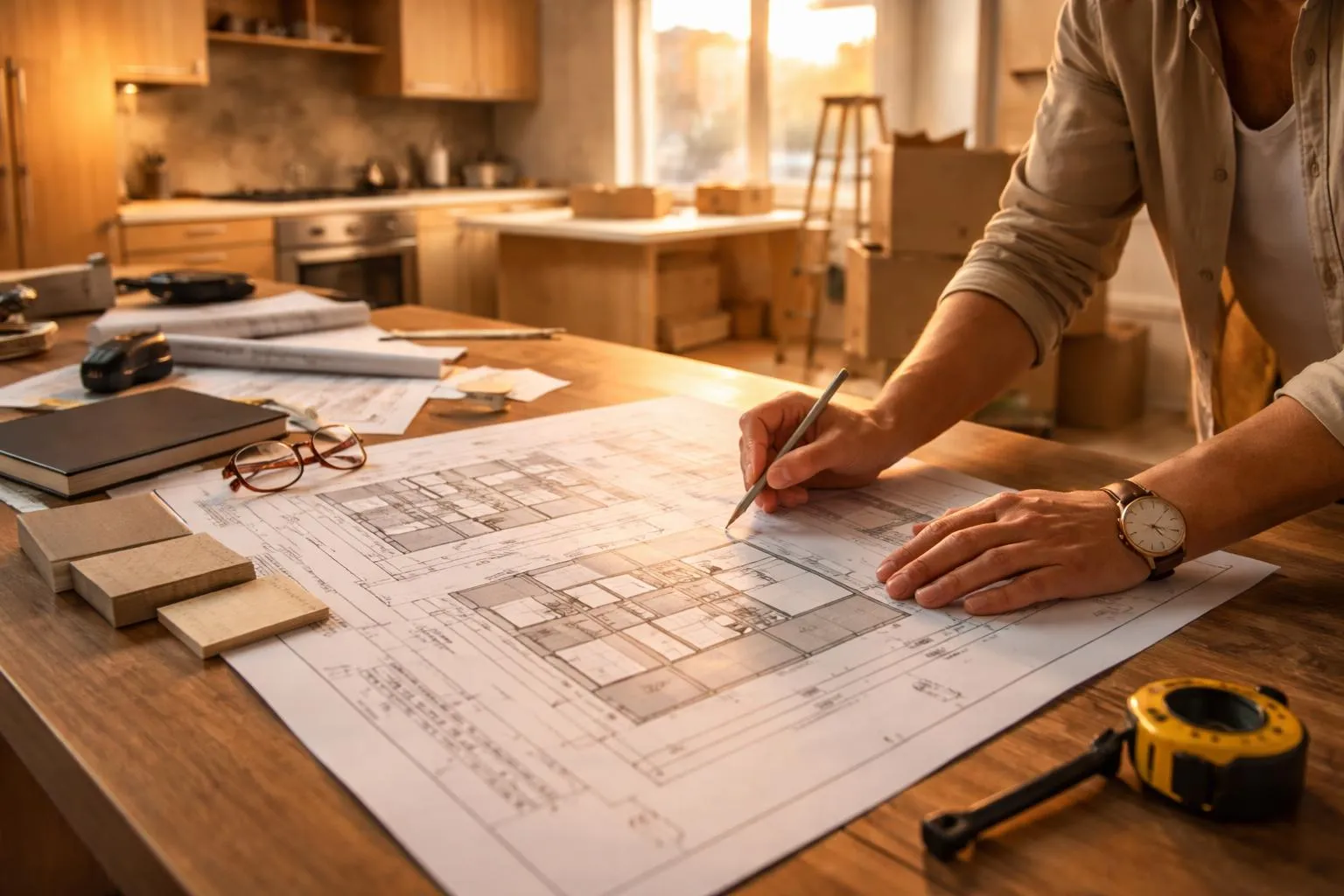
A lot of people treat design as the “nice to have” part of a kitchen renovation. The fun part. The cosmetic part. The part you add if the budget allows.
I think that’s backward.
If you want to save time and money, reduce stress, and end up with a kitchen that actually works, design should come first. A good design partner is not there just to pick colors or make things look polished. They help prevent expensive mistakes, tighten the decision-making process, and make sure the kitchen can be built the way it was imagined.
That matters whether you’re a homeowner planning a remodel, a builder managing new construction, or someone coordinating with a cabinet maker and countertop supplier on a deadline.
Kitchen projects go wrong in very predictable ways. Measurements are rushed. Storage needs are guessed at. Appliances get selected too late. A beautiful island blocks circulation. A counter top choice looks great online but stains too easily for a busy household. Cabinets are ordered before plumbing or electrical details are fully sorted. Then the change orders start.
A vetted designer helps stop that cycle before it begins.
People sometimes assume professional design adds cost. In a narrow sense, yes, it does. But that’s not the full math.
The real question is this: what does it cost to get the project wrong?
A kitchen renovation includes moving parts that affect each other. Cabinet design influences appliance placement. Appliance placement affects electrical and ventilation planning. Plumbing locations affect sink base sizing. Countertop material affects support requirements, edge details, and seam placement. Even simple decisions, like drawer widths or pantry depth, can change how the room feels and functions every day.
When one decision is made in isolation, another part of the project usually pays for it later.
That’s why working with a design partner often saves money in practice. You spend more time planning, but less time fixing. You make fewer rushed purchases. You avoid ordering the wrong products. You reduce site surprises. And you get far more renovation confidence before construction starts.
This is probably the least glamorous benefit, and maybe the most valuable.
An experienced designer has seen the common trouble spots before. They know which ideas look good on paper but fail in real kitchens. They know where budgets usually drift. They know the questions clients often don’t think to ask until it’s too late.
In kitchen renovation work, the details behind the walls matter just as much as the finishes in front of them. Plumbing lines, HVAC runs, electrical locations, load-bearing conditions, ceiling variations, and appliance specs can all affect the final layout. If those constraints aren’t considered early, the plan may need to be redrawn after materials are already selected or ordered.
That gets expensive fast.
A good design partner also helps bridge the gap between vision and buildability. That’s especially useful when multiple trades are involved. The contractor may focus on schedule. The cabinet maker may focus on dimensions, joinery, and installation requirements. The countertop fabricator may care about spans, seams, and support. Someone needs to see how those pieces fit together.
A designer often fills that role.
Imagine a homeowner wants a large island with seating, storage on both sides, a prep sink, and a waterfall counter top. On a mood board, that sounds great. In the actual room, the clearances may be too tight, the sink plumbing may interfere with drawer storage, and the slab size may create an awkward seam.
A designer catches that before anyone orders stone or starts rough-in work.
That is how you avoid costly mistakes. Not through magic. Through planning.
Most people underestimate how much time gets lost in back-and-forth.
A kitchen project can drag for months before construction even begins if the process is loose. One meeting to discuss style. Another to review layouts. Then a trip to compare finishes. Then a pause because appliance sizes changed. Then new pricing. Then another revision because the budget moved. It becomes a chain reaction.
A strong design partner brings structure to that process.
They usually work through a clear sequence: discovery, measurements, layout options, product selection, pricing review, revisions, and final sign-off. That sounds simple, but structure is what keeps a project moving.
Instead of revisiting every decision over and over, you narrow decisions at the right time. You look at the layout before choosing hardware. You settle appliance specs before finalizing cabinet sizes. You review realistic pricing before falling in love with options that break the budget.
That kind of streamlined design process helps in a few practical ways:
fewer unnecessary meetings
less confusion between trades and suppliers
quicker approvals
fewer showroom visits
faster movement from idea to order
For busy homeowners, this means less disruption to daily life. For builders and project managers, it means fewer schedule gaps caused by unresolved design questions.
Time matters. Delays cost money even when nobody sends you a formal invoice for them.
This is where experience really shows.
Many renovation problems start with product selection that looks good at first and disappoints later. A finish scratches easily. Hinges don’t hold up. Shelving isn’t suited to the weight it needs to carry. The chosen counter top material requires more maintenance than the household can realistically give it. Storage looks clean in photos but doesn’t fit the items people use every day.
A designer helps match products to real use.
That doesn’t mean choosing the most expensive option. Often it means doing the opposite. A well-informed designer can tell you where to spend and where to pull back without hurting function.
For example:
A family with young kids may need durable, easy-clean cabinet finishes more than specialty door profiles.
A serious home cook may benefit from drawer storage, workflow planning, and heat-resistant surfaces more than decorative shelving.
A rental or multi-unit project may need consistent, reliable materials that are easier to source and maintain at scale.
A new construction build may need cabinet design decisions made early enough to keep trades coordinated and avoid site delays.
This is where a design partner can help you get better value from the same budget.
They also tend to know how products work together. Cabinet interiors, hardware, door styles, accessories, and surface materials should not be selected as isolated items. They’re part of one system. If the system is coherent, the kitchen feels intentional. If it isn’t, you can end up paying for upgrades that don’t improve day-to-day use.
Cabinets and countertops take up a big share of the budget in many kitchen projects. They also shape the room more than almost anything else. Poor choices here are hard to hide and expensive to correct.
That’s why product selection should never be rushed.
A capable designer can guide conversations with your cabinet maker, confirm dimensions, think through storage details, and help compare counter top materials based on wear, maintenance, edge style, thickness, and budget. That leads to decisions that hold up after the renovation dust settles.
A floor plan is useful. For many clients, it’s also a little abstract.
You might understand that a pantry is 24 inches deep and the island has a 42-inch walkway. But that doesn’t always tell you how the room will feel. It doesn’t always help you picture whether upper cabinets will seem heavy, whether the fridge enclosure is too dominant, or whether the seating area will feel cramped.
This is where 3D renderings help.
Good 3D renderings give clients a more realistic sense of the finished space before construction starts. They show proportion, sight lines, cabinet relationships, finish combinations, and critical dimensions in a way that is much easier to interpret than a line drawing alone.
That does two important things.
First, it speeds up decision-making. People spend less time guessing and more time reacting to something they can actually see.
Second, it reduces the risk of mid-project layout changes. Those changes are usually painful. They can affect cabinet orders, electrical positions, tile layout, lighting, and installation timing. Catching uncertainty in the design phase is far cheaper than catching it after demolition.
A client may think they want stacked upper cabinets to the ceiling. In a 3D view, they realize the room height makes the kitchen feel top-heavy. Or they see that an open shelf beside the hood looks stylish but leaves little practical storage. That kind of clarity can save hours of indecision and thousands in rework.
3D renderings don’t replace technical drawings. They complement them. Together, they give people a far better shot at making confident decisions.
This might be the biggest point of all.
Designers who are worth hiring usually slow the process down at the beginning. That can feel annoying if you’re eager to get started. But rushing the planning phase is one of the most expensive habits in renovation.
Getting it right the first time means asking better questions early:
How does the kitchen need to function day to day?
Who cooks here, and how often?
What needs to be stored, and where does it make sense to store it?
Are appliance sizes confirmed?
Will existing plumbing and electrical stay where they are?
Is accessibility a concern now or later?
What is the real budget, including installation and related trade work?
What level of finish quality makes sense for this project?
These questions may seem basic. They are not. They shape the entire scope.
A thoughtful design partner fine-tooth-combs the project before things are ordered and scheduled. They identify constraints. They spot inconsistencies. They help define what matters most so the budget can support it.
That is how you reduce rework, change orders, and surprise costs.
The planning phase is where the savings are hiding.
Let’s make this more concrete.
A homeowner skips design help to save money. Cabinets are ordered based on a rough layout. Once demolition starts, it becomes clear the fridge door clearance is poor, the microwave location is awkward, and the island overhang needs extra support. Revisions follow. Some materials can’t be returned. The “saved” design fee disappears quickly.
A builder working on new construction needs cabinet design finalized so other trades can stay on track. A design partner coordinates dimensions, appliance specs, and product selection early. Because those decisions are locked in sooner, the cabinet maker, electrician, and countertop team can work from a clear plan. Fewer site calls. Fewer pauses. Better sequencing.
A family wants a kitchen that looks clean but also handles school lunches, bulk groceries, and daily cooking. The designer recommends more drawers, a better pantry layout, durable finishes, and a work triangle that suits the room. The kitchen may not look radically different in photos, but it works much better in real life. That’s the kind of improvement people notice every day.
Not every designer works the same way. If you’re comparing options, look past style alone.
Ask whether they have worked on projects similar to yours. Renovation and new construction are different. A designer who understands construction realities is often more useful than one who only shows beautiful images.
A good designer should be able to explain how the project moves from first meeting to final approval. If the process feels vague, expect confusion later.
Photos show taste. Drawings show discipline. Ask whether they provide detailed layouts, dimensions, and 3D renderings.
A vetted designer usually asks a lot up front. That’s a good sign. If someone jumps straight to finish choices without talking through function, scope, and constraints, I’d be cautious.
Kitchen projects depend on coordination. Ask how they communicate with the cabinet maker, contractor, installer, and countertop fabricator. The smoother that relationship, the smoother the project.
Most kitchen projects begin with a conversation about goals, measurements, budget, and timeline. After that, you’ll usually move into layout development, then cabinet design details, then materials and finish selections.
At some stage, 3D renderings may be introduced so you can evaluate the design visually. Pricing is often refined as selections become more specific. Final approvals happen once the layout, products, and scope are confirmed.
That sequence matters. It turns a stressful renovation into a series of manageable decisions.
And that’s the real value here.
A good design partner does not remove every decision from your plate. They make sure you’re making the right ones, in the right order, with enough information to feel confident.
If you’re planning a kitchen renovation, building a new home, or coordinating custom cabinetry and surfaces, hiring a design professional is not an indulgence. It’s often the smarter financial choice.
The right designer helps you save time and money by reducing mistakes, improving product selection, tightening the process, and giving you a clearer picture of what you’re building before work begins. They help turn uncertainty into decisions you can stand behind.
That’s worth a lot in any renovation.
If you’re weighing whether to bring in a design partner, think beyond the design fee. Think about the avoided revisions, the smoother timeline, the stronger cabinet design, the smarter counter top choice, and the simple relief of knowing the plan makes sense before construction starts.
In kitchen work, confidence is not fluff. It’s part of the budget.

.png)


