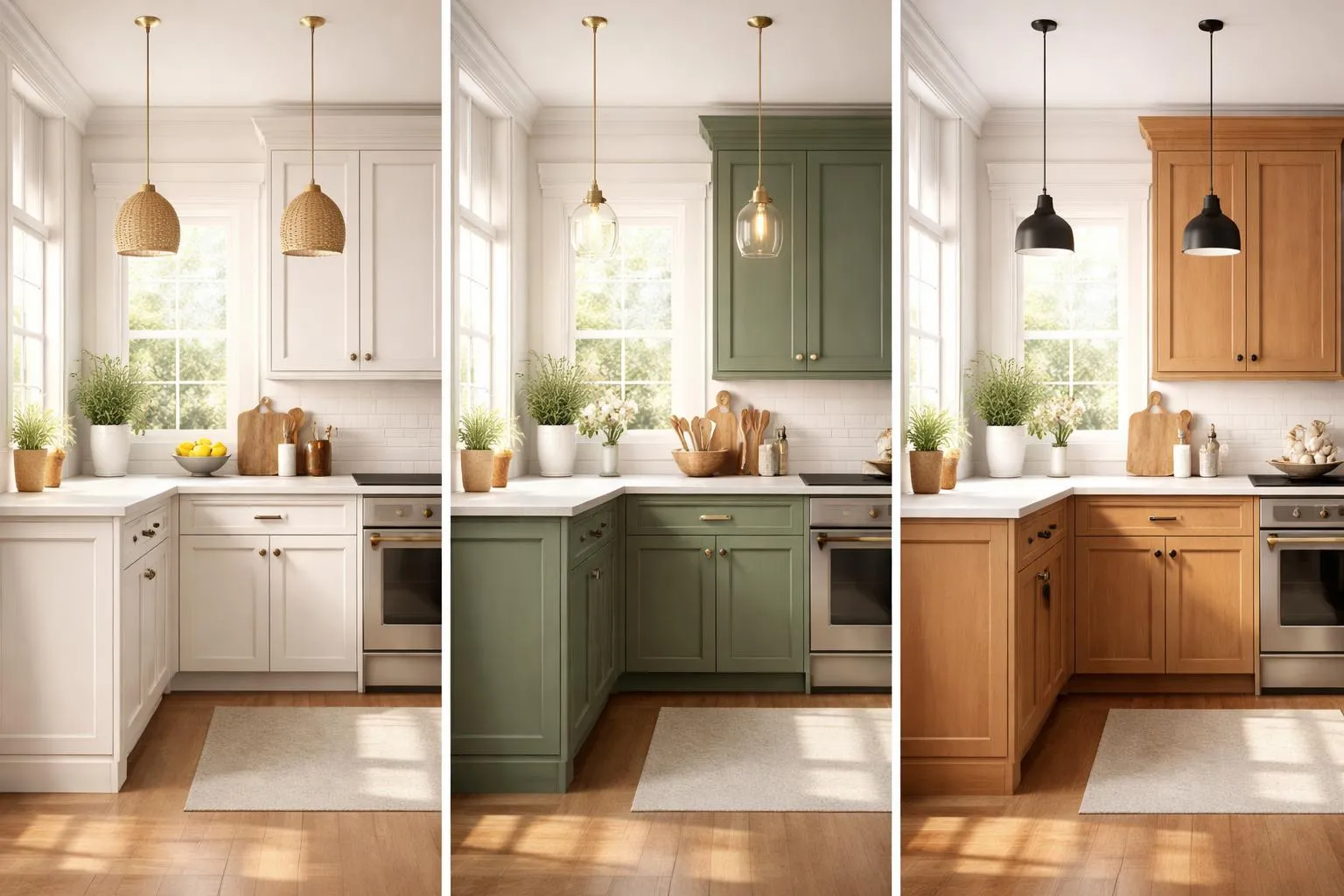
If you have started shopping for cabinets, you have probably run into three labels right away: stock, semi-custom, and custom. People often treat those words like a ranking system, as if stock means basic, semi-custom means better, and custom means best. That is not really what they mean.
Those labels describe how cabinets are made, not whether they are good or bad.
That distinction matters more than it sounds. A well-built stock cabinet can outperform a poorly made custom cabinet. On the other hand, a beautifully made custom cabinet may be the only sensible choice in a room with crooked walls, an odd ceiling height, or an awkward alcove that standard sizes cannot handle.
So the real question is not, “Which type is best?” It is, “Which manufacturing method fits this project?”
That is where many buyers get stuck, especially during renovations. New homes with predictable dimensions are one thing. Older homes are another story entirely. Floors slope. Walls bow. Corners are not square. A standard cabinet plan that looked neat on paper can get messy fast once measurements meet reality.
This guide breaks down what each category means, how it affects fit, lead time, cost, and daily use, and how to choose the right cabinet design for your space without getting distracted by labels.
Cabinet shopping blends design talk with construction talk, and the two do not always mean the same thing. A buyer hears “custom” and thinks luxury. A contractor hears “custom” and thinks made to order. Both reactions are understandable, but only one is technically accurate.
In cabinetry, the label usually refers to production method.
Stock cabinets are pre-made in fixed sizes. Semi-custom cabinets start from a standard line but allow more choices. Custom cabinets are built to your exact specifications.
None of that tells you, by itself, whether the cabinet box is sturdy, whether the hinges are reliable, whether the finish will hold up, or whether the drawers glide smoothly ten years from now.
That is why these terms cause so much confusion. People assume the manufacturing category answers every question. It does not. It answers one important question: how much flexibility you have before the cabinet is built.
Stock cabinets are manufactured in standard dimensions and kept in inventory or made in repeatable batches. They are the most standardized option.
In many product lines, widths are available in fixed increments, often 3 inches. Heights and depths also follow preset dimensions. You choose from the sizes and styles the manufacturer already offers.
That standardization creates two big advantages.
First, stock cabinets are usually the fastest option. Because they are already produced, or close to it, delivery is often quicker than with cabinets that need more configuration or shop time.
Second, stock cabinets usually have the lowest upfront price. Manufacturers save money by making large volumes of the same cabinet sizes and styles, and that efficiency often shows up in the final cost.
For straightforward projects, that can be perfectly fine. A simple kitchen in a newer home, a laundry room with standard wall lengths, or a rental unit where speed matters more than tailored details can all be good candidates.
But stock cabinets are less forgiving when the room is not standard. If your wall length falls between available sizes, the installer may need wider fillers or other adjustments to make everything fit. Sometimes that is minor. Sometimes it changes the look more than expected.
This is where disappointment starts. A buyer chooses stock to save money, then ends up paying for field modifications, trim solutions, or layout compromises that were not obvious at the beginning.
Stock cabinets are not wrong. They are just less flexible.
Semi-custom cabinets live in the middle, and honestly, that middle ground is where many projects belong.
Like stock cabinets, semi-custom options usually begin with a standard catalog or manufacturing line. The difference is that the manufacturer offers more sizes, more finish choices, more accessories, and often more ways to adjust the cabinet to the room.
You might be able to choose modified widths, different door styles, deeper drawers, interior organizers, glass inserts, specialty pull-outs, or expanded finish options. The exact menu varies by manufacturer, but the idea is consistent: the cabinet is not built from scratch, yet it is not fully locked into a narrow set of standards either.
This added flexibility solves a lot of common renovation problems.
Maybe your kitchen wall is just a little off from a standard layout. Maybe you want better storage near the range. Maybe your vanity area needs a more specific width to work with plumbing and a double-sink counter top. Semi-custom often handles those situations without the full cost and time commitment of custom fabrication.
That is why semi-custom is so popular. It gives buyers room to improve fit and function while staying within a more predictable production system.
The trade-off is lead time and price. Semi-custom usually takes longer than stock because the order is more specific, and it costs more because the manufacturer is doing more with each unit. Still, for many people, the added cost feels easier to justify because the benefits are visible in everyday use.
Custom cabinets are built to the customer’s exact requirements. Size, style, wood species, finish, door profile, storage details, and layout can all be tailored to the project.
This is the option with the fewest dimensional limits. If you have a narrow alcove, an unusually tall ceiling, a historic home with uneven walls, or a design that depends on exact symmetry, custom cabinets give you the most control.
That control matters in rooms where standard increments simply do not make sense. A filler strip that feels acceptable in one kitchen may look awkward in another. A stock-depth vanity may interfere with a doorway. A semi-custom line might get close, but “close” is not always good enough.
Custom cabinetry is also the category where collaboration becomes much more important. The designer, installer, and cabinet maker all need to think carefully about how the room works, not just how it looks. Good custom work involves measurement, planning, shop drawings, approval, production, finishing, and installation. There are more steps because there are more decisions.
That usually means longer lead times. It also means higher costs.
Still, in the right project, custom is not an indulgence. It is the practical solution. If the room is highly irregular, forcing standardized cabinets into it can create more waste, more filler, more visual compromise, and sometimes more labor onsite. In those cases, custom work may cost more at the start but solve more problems cleanly.
Custom is also the best route when the cabinet design itself is unusual. Think integrated appliance panels, special storage for cooking tools, furniture-style built-ins, or cabinetry that must meet exact architectural details.
This is the point that deserves repeating: stock, semi-custom, and custom do not automatically tell you how well a cabinet is made.
A cabinet’s quality depends on things like:
Box construction
Material thickness
Joinery
Drawer hardware
Hinge quality
Finish durability
Installation accuracy
You can find weak materials in a custom shop and excellent materials in a stock line. You can also find the reverse.
That is why buyers should stop treating the label as a shortcut. It is tempting, I know. Shopping is tiring, and everyone wants a simple answer. But “custom” does not guarantee durability, and “stock” does not guarantee compromise.
Ask what the cabinet box is made from. Ask about drawer construction. Ask whether shelves are adjustable and what weight they can handle. Ask about finish options in spaces that deal with moisture, heat, or heavy cleaning.
If you are working with a cabinet maker directly, ask to see samples, recent work, or shop details. If you are buying through a dealer, ask which parts are standard and which are upgrades.
That kind of information is much more useful than the label alone.
A room can look square enough until measurements start stacking up.
Older homes are famous for this. One wall may be out by half an inch, the floor may dip, and the ceiling may slope just enough to make a full-height cabinet look off. Even newer homes are not perfectly precise. Construction tolerances add up.
This is where cabinet category affects the project in a very real way.
Stock cabinets work best when room dimensions cooperate with standard sizes. When they do, the result can be efficient and clean. When they do not, installers may need to use fillers, scribes, trim, or layout adjustments to bridge the gap.
Semi-custom gives you more room to solve those issues before installation day. You may be able to tweak a width, choose a different cabinet combination, or adjust storage features so the room works better.
Custom lets you build to the room instead of forcing the room to accept a fixed system.
That difference also affects countertop planning. A counter top is templated after cabinets are set, so cabinet fit influences seam placement, overhang consistency, appliance spacing, and sink alignment. If the cabinets require too much field adjustment, the downstream work can become less tidy than expected.
In other words, cabinet fit is not just about cabinets. It affects the whole room.
Buyers often focus on style and price first, then treat lead time like a side note. I think that is a mistake.
Production timelines shape the entire renovation schedule.
Stock cabinets are usually the fastest because they are pre-manufactured. If the product is in inventory, the wait may be short. That speed can be a major advantage if you are trying to finish a rental turnover, replace damaged cabinets quickly, or keep a renovation from dragging on.
Semi-custom takes longer because there are more choices to process and more ordering coordination involved. It is still generally more predictable than full custom, but you should expect a longer wait than off-the-shelf products.
Custom cabinets take the most time. Measurements need to be confirmed. Drawings often need approval. Materials may be selected specifically for the job. Production is done to order, not pulled from a warehouse.
None of this makes one option better than another. It just means the timeline has to match the project. If you need the room functional as quickly as possible, a fully bespoke solution may be frustrating even if it looks ideal on paper.
Stock cabinets usually win on sticker price. That is real, and for many budgets it matters a lot.
But value is more complicated.
If stock cabinets fit your room well and meet your storage needs, they can be a smart buy. If they require heavy modification, leave awkward dead space, or force a clumsy layout, the initial savings may not feel so impressive later.
Semi-custom often appeals to buyers who want better fit and more choices without stepping into full custom pricing. That is a reasonable place to land. In fact, it is often the most balanced choice for ordinary renovations where the room is not wildly irregular but still benefits from some tailoring.
Custom cabinets cost more because more labor, planning, and material control go into them. The value shows up when exact fit, unusual dimensions, or detailed features matter enough to justify the spend.
I would frame it this way: cost is what you pay now, value is what the room gives back over time. Better storage, smoother use, fewer compromises, and less visual patchwork all count.
There is no universal answer, but some patterns are pretty consistent.
For standard new construction or simple room updates, stock cabinets often make sense. If the layout is predictable and the available sizes work, there may be no reason to pay for more flexibility than you need.
For renovations with a few dimensional issues, semi-custom is often the practical compromise. It helps refine fit, storage, and finish choices without moving the whole project into made-from-scratch territory.
For older homes, unusual floor plans, built-ins, specialty storage, or highly specific design goals, custom cabinets are often the better tool for the job.
A good rule is simple: the more your room deviates from standard assumptions, the more useful customization becomes.
Before you choose a category, slow down and ask a few plain questions.
How standard is the room, really?
Will fixed cabinet sizes leave large fillers or wasted space?
How important is fast delivery?
Do you need special storage features or unusual dimensions?
Is your budget tight at the cabinet purchase stage, or across the full renovation?
Are you judging quality based on the label, or on the actual materials and construction?
Those questions usually bring clarity faster than browsing door styles for three hours.
It helps to stop treating stock, semi-custom, and custom as levels on a ladder. They are different manufacturing approaches with different strengths.
Stock is about speed, simplicity, and cost control.
Semi-custom is about flexibility within a structured system.
Custom is about precision, freedom, and problem-solving for spaces that do not fit standard rules.
Once you see the categories that way, the decision gets less emotional. You are not choosing the “best” cabinet in the abstract. You are choosing the cabinet type that makes the most sense for your room, your schedule, your budget, and the way you want the space to function.
That is a much more useful question, and usually a much cheaper mistake to avoid.

.png)


