
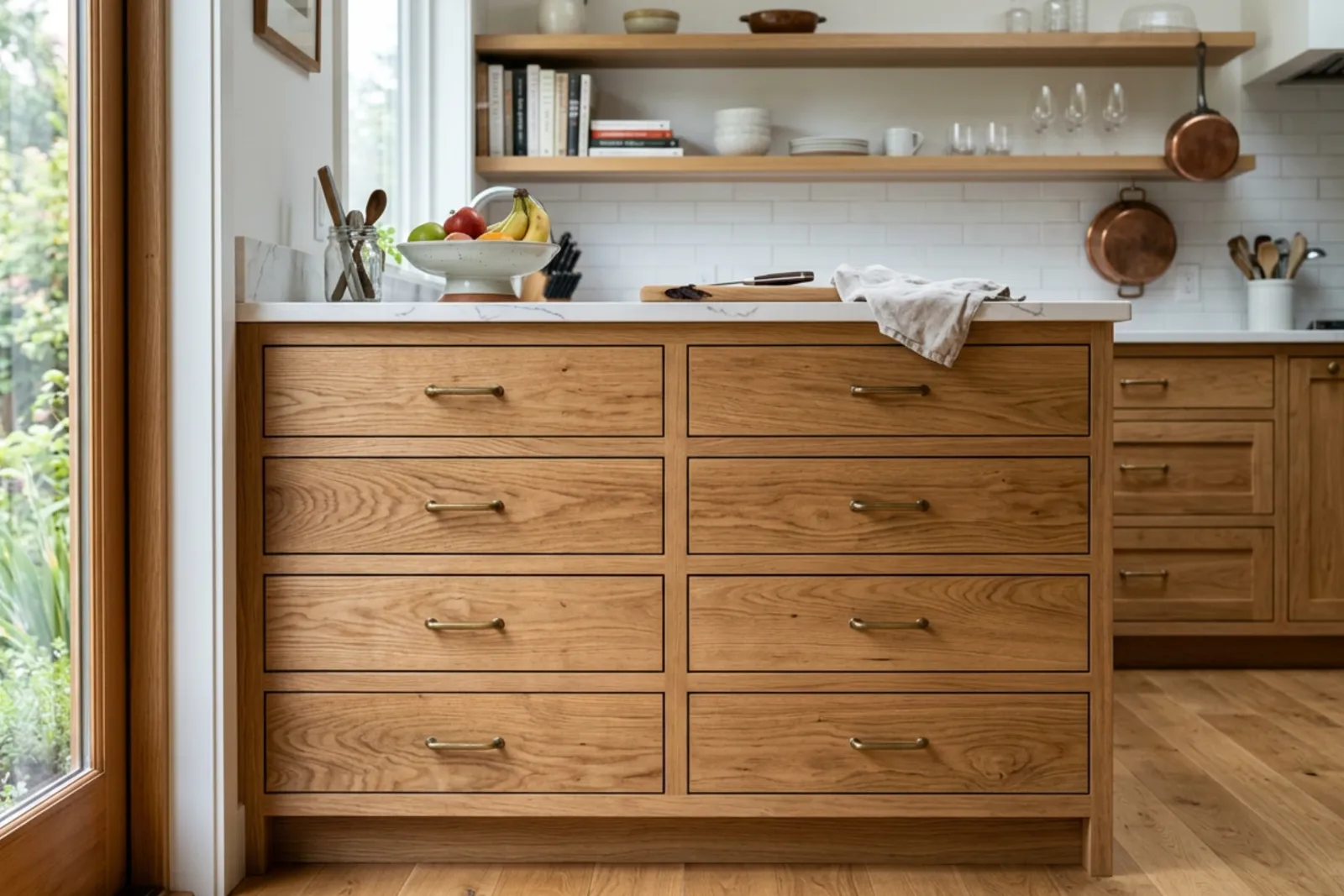
A finished kitchen can look impressive in a photograph. The harder question is whether that image tells you anything useful about the cabinet maker behind it.
Project photos are a good starting point for comparing professionals, refining your preferences, and deciding whom to contact. They can show how someone handles a compact kitchen, coordinates wood finishes, or fits storage into an awkward room. But attractive lighting and carefully chosen camera angles can also hide details you need to understand.
The most useful approach is to treat a portfolio as evidence, not a promise. Look for projects that resemble your needs, examine the details, and use captions and reviews to fill in what the images cannot tell you. Here is how to do that with a more critical eye.
Start With Projects That Resemble Your Home
It is easy to get distracted by a spacious kitchen with an oversized island. If your renovation involves a narrow galley kitchen, that project may have little to teach you about how your space should work.
Begin with room type and scale. Look for kitchens, bathrooms, laundry rooms, or built-ins that have constraints similar to yours. A cabinet maker who has completed several small kitchens may have useful experience with limited counter space, tight corners, and storage that must work especially hard.
The match does not have to be exact. An L-shaped kitchen with a peninsula might reveal more relevant planning choices than a larger room in your preferred color.
Use Local Examples for Context
For homeowners in North Burnaby, projects in nearby communities can provide helpful context. You may recognize familiar housing types, ceiling heights, or room arrangements. Photos of renovations in established homes can also show how new cabinetry meets existing floors, walls, and trim.
Still, location alone does not prove suitability. Two homes on the same street can have very different renovation requirements. Use local examples to ask better questions about experience and service coverage, rather than assuming a nearby project will translate directly to your home.
Read the Cabinet Design Before the Styling
Decorative objects, pendant lights, and a striking backsplash can dominate a photograph. Try mentally removing them. What remains is the cabinet design itself.
Look at the door profile, the arrangement of drawers and cupboards, and the proportions of the larger cabinet groups. Do tall cabinets feel balanced with the rest of the room? Are upper cabinets arranged deliberately, or do they appear squeezed around windows and appliances?
Flat-panel doors create a relatively uninterrupted surface. Recessed-panel doors add depth and can suit several styles, depending on their proportions and finish. More decorative profiles introduce additional detail. None is inherently better, but each creates different visual demands.
Simple-looking cabinetry can be particularly revealing. Long, flat surfaces and repeated lines make uneven alignment easier to notice. Decorative cabinetry deserves equally close attention, especially where profiles meet at corners or continue across adjoining sections.
The goal is not to decide whether a room follows a particular style label. It is to see whether its details work together.
Examine Materials and Finishes With Caution
Photos can suggest texture and color, but they are unreliable samples. Daylight, artificial lighting, camera settings, and editing can all change how a finish appears.
A white cabinet may look warm in one image and cool in another. Wood grain can seem stronger or softer depending on the angle of the light. Use images to identify a direction, then confirm it with physical samples.
Look for Specific Material Information
A caption that identifies “rift-cut white oak with a graphite stain” tells you far more than one that says “custom wood kitchen.” The species, cut, and stain each affect the result. Rift-cut white oak is often chosen for its relatively straight grain, while a stain changes its color without necessarily concealing that grain.
For painted cabinetry, a named color such as Simply White is a useful reference point, but it is not a complete finish specification. Confirm the paint manufacturer, coating system, and sheen. The application process and underlying material also matter.
Ask what is solid wood, what is veneer, and what is used for the cabinet boxes and painted components. Many of these distinctions cannot be established from a finished-room photograph.
Check Continuity, Not Just Color
Across several photos, look for intentional grain direction and reasonably consistent color on adjoining parts. Where grain appears to continue across drawer fronts, ask whether that matching was specified.
Wood has natural variation, and a photograph cannot establish whether every difference is desirable or accidental. What matters is understanding the intended result and how the maker selects and arranges visible materials.
Judge Layout Through Everyday Tasks
A successful photograph shows how a room looks. Your job is to consider how it might feel to use.
In a kitchen, trace an ordinary task: taking food from the refrigerator, washing produce, preparing it, and reaching the cooking area. Notice whether useful work surfaces are nearby. Consider whether an open dishwasher or refrigerator door could interrupt movement.
A single image rarely provides enough information to judge clearances accurately. Wide-angle photography can make an aisle look larger than it is. Plans and measurements are needed before drawing firm conclusions.
Even so, photos can reveal questions worth asking. A large island may leave little circulation space. A corner may appear difficult to access. A drawer stack near the preparation area may offer practical storage for utensils and tools.
Look Beyond Kitchens
Other rooms reveal different planning skills.
In a bathroom, cabinetry needs to accommodate plumbing while preserving useful storage. Look at the relationship between drawers, doors, sinks, and nearby walls. Photos will not confirm moisture resistance, so ask about materials, finishes, and care requirements.
In a laundry room, check how cabinets relate to appliance doors, work surfaces, and access for maintenance. Upper cabinets may add storage, but their height affects reach. A caption with room dimensions or cabinet heights helps you judge whether a similar arrangement would suit your household.
Built-ins in dining rooms or living areas can show how a maker handles proportions and transitions to existing architecture. These projects may be useful even when you are primarily planning a kitchen.
Inspect Visible Workmanship Without Overclaiming
Close-up images are valuable because full-room photographs can conceal small inconsistencies.
Look for even gaps between doors and drawer fronts, consistent alignment, and clean-looking transitions around finished end panels. Notice how cabinetry meets ceilings, walls, and trim. Fillers and scribe pieces are normal parts of fitted cabinetry, especially where existing surfaces are uneven. The question is whether those transitions look considered.
Exposed ends deserve attention too. They may be finished with a simple panel, a matching door-style panel, or another treatment. Compare the result with the rest of the design rather than assuming one approach is always preferable.
Be careful with apparent defects. Perspective can make straight lines look distorted, and reflections can resemble finish flaws. If something concerns you, ask for another view instead of treating one image as proof.
Photos also cannot reliably establish drawer operation, hinge adjustment, cabinet-box construction, or how securely the cabinets are installed. A portfolio with no interior views leaves those matters unanswered. It does not automatically indicate poor work.
Separate Cabinetry From the Rest of the Room
A finished room is usually the work of several people. The cabinet maker may have supplied the cabinetry without selecting or installing the countertops, backsplash, flooring, lighting, or appliances.
This distinction matters when you admire a particular combination. A marble backsplash or quartzite countertop may make the cabinets more appealing, but it does not necessarily demonstrate the cabinet maker’s skill in sourcing or installing stone.
Look for captions that identify responsibilities. Useful project notes explain which parts were designed, fabricated, supplied, or installed by the cabinetry professional and which were handled by others.
Then consider the connections between materials. Does the countertop edge suit the cabinet proportions? Is the backsplash termination resolved neatly? How do appliance panels relate to neighboring doors?
These junctions often require coordination. Ask who will confirm dimensions and manage those decisions on your project, especially when separate trades are involved.
Use Captions to Test Your Understanding
A detailed caption turns an attractive image into a more useful reference. Location, room type, layout, door profile, and finish information help explain what you are seeing.
Measurements are particularly helpful. A photograph of laundry-room cabinets means more when you know the room width or upper-cabinet height. Without that context, it is easy to mistake a solution that photographs well for one that will fit your space.
Project descriptions can also explain constraints that images leave out. Perhaps the renovation retained the existing floor, worked around a window, or incorporated independently purchased appliances. Those details help you understand why the cabinetry looks the way it does.
Missing information is a reason to ask a question, not necessarily a reason to reject a professional. Some capable makers maintain simple portfolios. What matters next is whether they can explain the work clearly and provide relevant details.
Compare Several Projects, Then Read Reviews
One outstanding room is encouraging. A series of well-resolved projects provides stronger evidence of consistency.
Look for repeated care across different budgets, styles, and room sizes. A broad portfolio may demonstrate versatility, while a more focused one may show deep experience with the kind of cabinetry you want. Neither is automatically superior.
Also check whether multiple images show one project or several distinct projects. Ten views of the same kitchen offer useful detail, but they do not establish consistency across ten installations.
Reviews add another kind of evidence. They may describe whether planning conversations were clear, questions received patient answers, and installation followed the agreed schedule. Comments about collaboration with a designer or contractor can be especially relevant if your renovation involves several professionals.
Read for specifics rather than praise alone. “The cabinets look beautiful” tells you less about the process than an explanation of how a measurement problem was resolved. Reviews remain individual accounts, so consider patterns across several reviews and compare them with what you learn directly.
Turn Your Findings Into a Practical Shortlist
You do not need to analyze every image in a portfolio. Select a few relevant projects from each cabinet maker and record what they demonstrate.
A simple comparison process keeps the research manageable:
Save examples that match your room type, approximate scale, and preferred style.
Note the visible details you like, such as drawer placement, wood grain, or ceiling-height cabinetry.
Separate confirmed information from assumptions about materials, dimensions, and workmanship.
Write questions about construction, finishes, installation responsibilities, and geographic coverage.
Compare the answers alongside the portfolio and review patterns.
Bring those images to an initial conversation, but explain what interests you about them. “I like the accessible drawers beside the cooking area” is more useful than “I want this kitchen.”
The strongest portfolio is not necessarily the most polished one. It is the one that gives you relevant examples, enough detail to evaluate them, and a clear basis for further discussion. Use the photos to narrow your choices. Then confirm the materials, measurements, scope, and expectations that a photograph can never fully explain.