
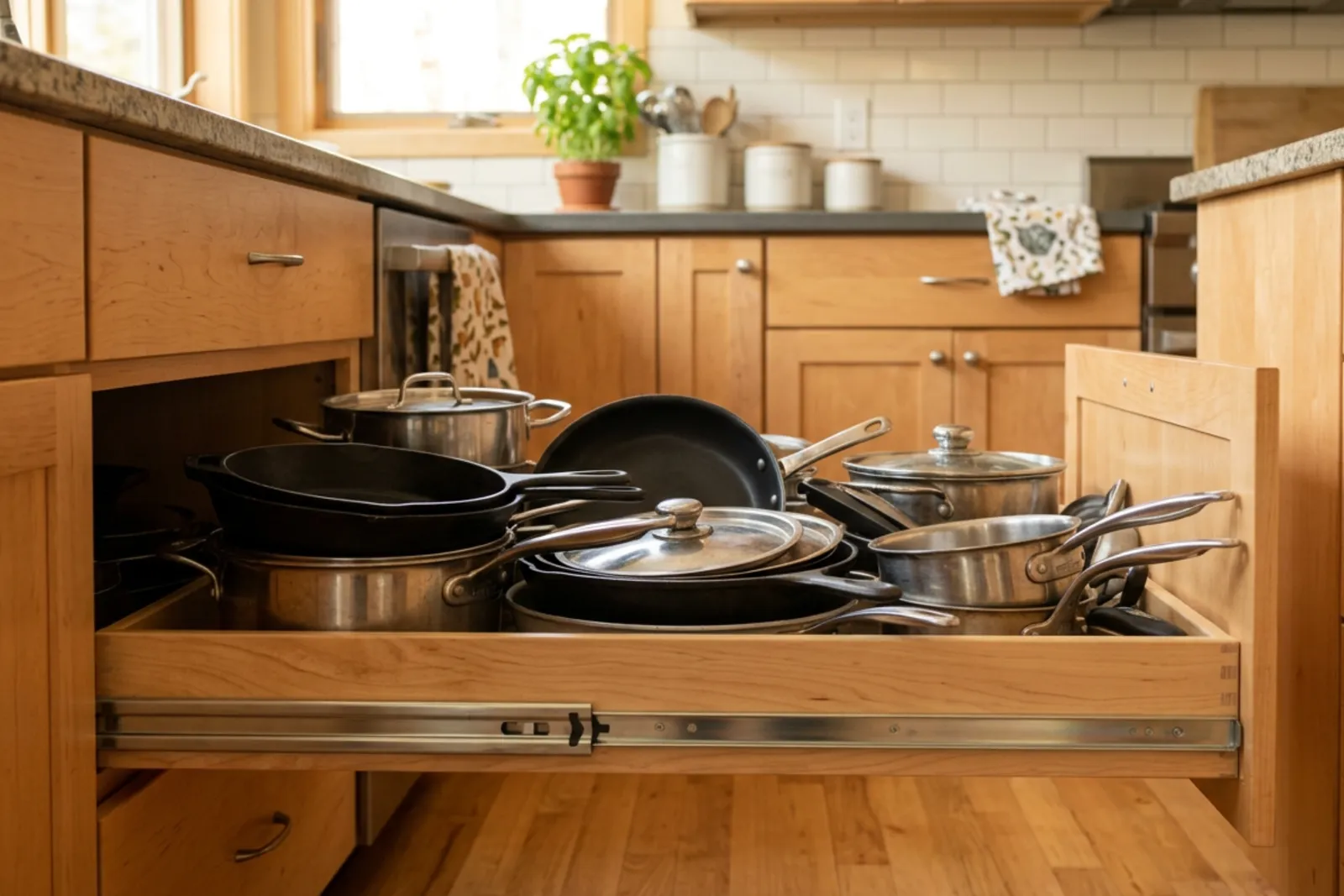
A kitchen cabinet quote can look straightforward until the hardware and storage accessories appear. Soft-close hinges, drawer organizers, waste pullouts, pantry systems, and corner mechanisms each sound useful. Together, they can push a comfortable renovation budget into uncomfortable territory.
For homeowners planning a mid-range kitchen in Burnaby or Vancouver, the challenge is deciding which upgrades will improve everyday use and which can wait.
Some choices belong in the original cabinet design because they affect cabinet dimensions, construction, or installation. Others are easy to add after you have lived with the kitchen for a few months. Knowing the difference helps you spend where it matters without paying for a mechanism behind every door.
The best starting point is simple: prioritize reliable movement and easy access before specialized organization.
Why Hardware Can Change a Cabinet Quote So Much
“Hardware” covers more than handles. It includes hinges, drawer slides, lift mechanisms, pullout frames, mounting brackets, and other moving components. Storage accessories add another layer, with trays, baskets, dividers, and purpose-built inserts.
A door-front cabinet with an adjustable shelf is relatively simple. Replace that shelf with several internal pullouts, and the cabinet needs more components, more installation work, and enough clearance for everything to operate properly.
Price differences also reflect construction. Two drawers that look similar may have different load ratings, adjustment options, extension lengths, and replacement-part availability. A heavy pot drawer asks much more of its slides than a shallow drawer holding tea towels.
Ask your cabinet maker to separate basic cabinet construction, standard hardware, and optional accessories in the quote. An itemized price makes it easier to compare useful upgrades rather than accept or reject an entire package.
Also ask what “standard” means. Soft-close operation, full-extension slides, and adjustable hinges should be specified rather than assumed.
Start With the Hardware You Will Use Every Day
The most valuable upgrades are often the least dramatic. A drawer that opens fully and closes consistently may improve daily cooking more than an elaborate pantry mechanism.
Full-extension drawer slides
Full-extension slides bring the drawer out far enough to make the back accessible. This matters in deep base cabinets, where utensils, containers, and cookware can otherwise disappear behind the drawer above.
Check the load rating for the complete drawer system, not just a loose slide component. Drawer size, installation, and the manufacturer’s requirements all affect suitability.
For pots, dishes, or small appliances, tell the cabinet maker what you plan to store. “Kitchen items” is too vague to guide a hardware choice.
Soft-close hinges and slides
Soft-close hardware reduces slamming and gives doors and drawers a controlled closing action. It is a sensible priority in a frequently used kitchen, especially when several people cook or clean at once.
Still, soft-close is a function, not a complete quality standard. Look for smooth movement, appropriate load capacity, good alignment, and accessible adjustment points. Ask whether replacement hinges or slides are readily available.
A poorly adjusted door with soft-close hardware is still a poorly adjusted door.
Handles and pulls
Handles affect comfort every time you open a cabinet. Test samples if possible. Check finger clearance, grip, sharp edges, and whether projecting ends could catch clothing.
Standard hole spacing can make future replacements easier, although replacement pulls must also cover any existing marks. Decorative finishes can wait for a larger share of the budget; comfortable operation should not.
Drawers Usually Deserve Priority Over Specialized Inserts
For many mid-range kitchens, replacing selected lower cupboards with drawers is one of the most useful design decisions.
Drawers bring stored items toward you. That reduces bending and reaching, and makes it easier to see what you own. Wide drawers can work well for pots, food containers, dishes, and utensils when their dimensions and hardware suit the load.
The important word is “selected.” Every base cabinet does not need to become a drawer stack. A sink cabinet has plumbing constraints. A tall appliance may need a different storage arrangement. Some households still benefit from a simple cupboard for bulky, rarely used items.
Think about drawer heights before approving the drawings. Several shallow drawers may look balanced on the elevation but leave nowhere for a stockpot. One very deep drawer may waste vertical space if it holds only small utensils.
Measure the things that are hardest to store. Then check usable interior dimensions, which are smaller than the cabinet’s outside measurements.
Simple removable dividers can come later. The drawer box and its opening cannot be changed nearly as easily.
A Waste and Recycling Pullout Often Earns Its Place
Waste storage deserves attention early because it affects cooking, cleanup, and circulation.
A pullout near the main preparation area can keep garbage, recycling, or food scraps accessible without leaving bins on the floor. In a compact kitchen, that can be a meaningful improvement.
But buying a multi-bin system does not guarantee that it fits your household. Check bin capacity, removal clearance, cleaning access, and the space needed for liners. Sorting requirements also vary by building and collection arrangement, so design around the system you actually use.
Under-sink placement can work, but plumbing, shutoff valves, and other equipment may restrict the available space. A separate base cabinet may be more practical when the layout allows it.
Ask how the pullout attaches and how it is rated for use. A waste cabinet gets opened frequently, sometimes with a full bin inside. This is a place to favor dependable hardware over decorative extras.
Corner Cabinets: Pay for Access, Not a Demonstration
Corner mechanisms can be impressive in a showroom. Trays swing out, baskets follow one another, and awkward storage suddenly looks manageable.
The decision is less obvious in a real kitchen.
A mechanism occupies space of its own. Its trays may not accommodate your largest cookware, and some systems need a particular door opening or cabinet configuration. Better access does not always mean greater storage capacity.
Before choosing a corner accessory, compare it with a basic shelf arrangement and with changing the surrounding layout. Depending on the room, accepting an unused corner may allow more useful drawers beside it.
There is no universal winner. A person who struggles to reach into a deep corner may reasonably value an accessible mechanism even if it stores less. Someone using that corner for a holiday roasting pan may prefer a simpler solution.
Request usable tray dimensions, load limits, and a demonstration of the exact system being quoted. Check whether nearby appliance handles or cabinet pulls interfere with the door’s movement.
Pantry Storage Should Match the Groceries You Buy
Tall pullout pantries put many items within reach, but they also concentrate weight on a moving system. They can be useful in narrow spaces when the hardware and dimensions are appropriate.
A wider pantry with doors and internal drawers may be a better fit for heavier groceries. Only the drawer you need moves, and different heights can accommodate cans, cereal boxes, or small appliances.
Adjustable shelves remain a valid budget choice. They are simple and flexible, particularly when the pantry is shallow enough that food stays visible.
The common mistake is specifying the mechanism before checking the contents. Bulk purchases, bags of rice, tall oil bottles, and snack bins all make different demands.
Map out what you regularly store and allow room to lift items out comfortably. A pantry that looks efficient on a drawing can feel cramped once ordinary groceries are inside.
Specialized Accessories Need a Specific Job
Spice pullouts, tray dividers, knife inserts, appliance lifts, and charging drawers can all be useful. Their value depends on your habits.
A narrow spice pullout may work beside a preparation area, but check bottle sizes and proximity to heat. Tray dividers can organize cutting boards and baking sheets with relatively little complexity. A custom knife insert is less compelling if you already prefer a wall-mounted rack.
Appliance lifts need particular care. Confirm the appliance’s weight, operating clearance, power access, and the manufacturer’s instructions. Do not assume every appliance can safely operate on a lift or inside a cabinet.
Electrical accessories should be reviewed with a qualified electrician. A charging drawer or concealed outlet must use a suitable product and comply with applicable electrical requirements. Ventilation and safe operation matter more than hiding cords.
A useful test is to finish this sentence: “This accessory solves the problem of…”
If the answer is vague, leave it off the first quote.
What to Decide Before Fabrication, and What Can Wait
The distinction is whether an upgrade changes the cabinet itself or simply organizes its contents.
Decide these items before approving fabrication:
Drawer stacks, drawer heights, and heavy-load storage requirements.
Cabinet widths and clearances for waste pullouts, pantry systems, and corner mechanisms.
Internal supports, door arrangements, and mounting needs for specialized hardware.
Electrical provisions and appliance storage that require coordinated design.
Accessibility needs that affect reach, opening force, or working clearance.
These decisions influence the cabinet boxes, doors, or surrounding layout. Retrofitting them can mean replacing components rather than adding an accessory.
Removable cutlery trays, nonslip liners, freestanding bins, and many adjustable drawer dividers can usually wait. Some internal pullouts can also be added later, but only if the opening, hinges, clearances, and cabinet construction permit it.
“Retrofit available” should never be treated as “will fit any cabinet.”
If you want to defer an accessory, ask the cabinet maker to confirm compatibility now. Keep the product specifications and cabinet drawings.
Coordinate Storage With Appliances and Countertops
Storage planning cannot happen separately from the rest of the kitchen.
A drawer beside a range may conflict with an oven handle. A dishwasher door may block access to the waste pullout. A refrigerator may need more opening clearance than the floor plan first suggests.
Countertop details matter too. Overhangs, supports, sink placement, and appliance requirements can affect the cabinetry below. A sink upgrade may reduce space for an under-sink organizer.
For Burnaby and Vancouver condo projects, check strata renovation requirements and delivery restrictions early. These vary by building, but they can affect scheduling and the practicality of late changes.
Request a final review that shows appliances, cabinet openings, and relevant clearances together. Attractive elevations alone do not tell you whether two neighboring components can open at the same time.
How to Compare Quotes Without Buying Every Upgrade
A useful quote review starts with your routine, not an accessory catalog.
Imagine putting away groceries, preparing dinner, unloading the dishwasher, and sorting waste. Which cabinets will you open repeatedly? Where will heavy items live? Which awkward reaches are you trying to eliminate?
Then ask for a base specification and separately priced upgrades. Compare quotes using matching quantities, dimensions, and hardware specifications. “Premium drawers” is not enough information for a fair comparison.
Clarify whether each price includes the mechanism, bins or inserts, installation, and required cabinet modifications. Ask who handles adjustments after installation and how hardware warranty claims are managed.
For a limited budget, a sensible sequence is reliable hinges and slides first, useful drawer layouts next, then accessories that solve a demonstrated problem. Decorative organizers can follow once the kitchen is in use.
That sequence is not absolute. Accessibility needs or a difficult layout may move a particular accessory to the top of the list.
Spend First on the Decisions That Are Hard to Undo
The strongest cabinet design is not the one with the longest accessory list. It is the one that makes ordinary tasks easier without adding unnecessary cost or complexity.
Choose dependable hardware. Plan drawer sizes around actual belongings. Resolve waste storage and difficult access before fabrication. Leave room in the budget for installation quality and final adjustments, because even good components need to be fitted properly.
You can buy a cutlery tray later. Changing an undersized cabinet opening is a different project.
That is the distinction worth keeping in mind when the quote arrives: pay early for the structure and movement you will rely on every day, then add organization where experience proves you need it.