
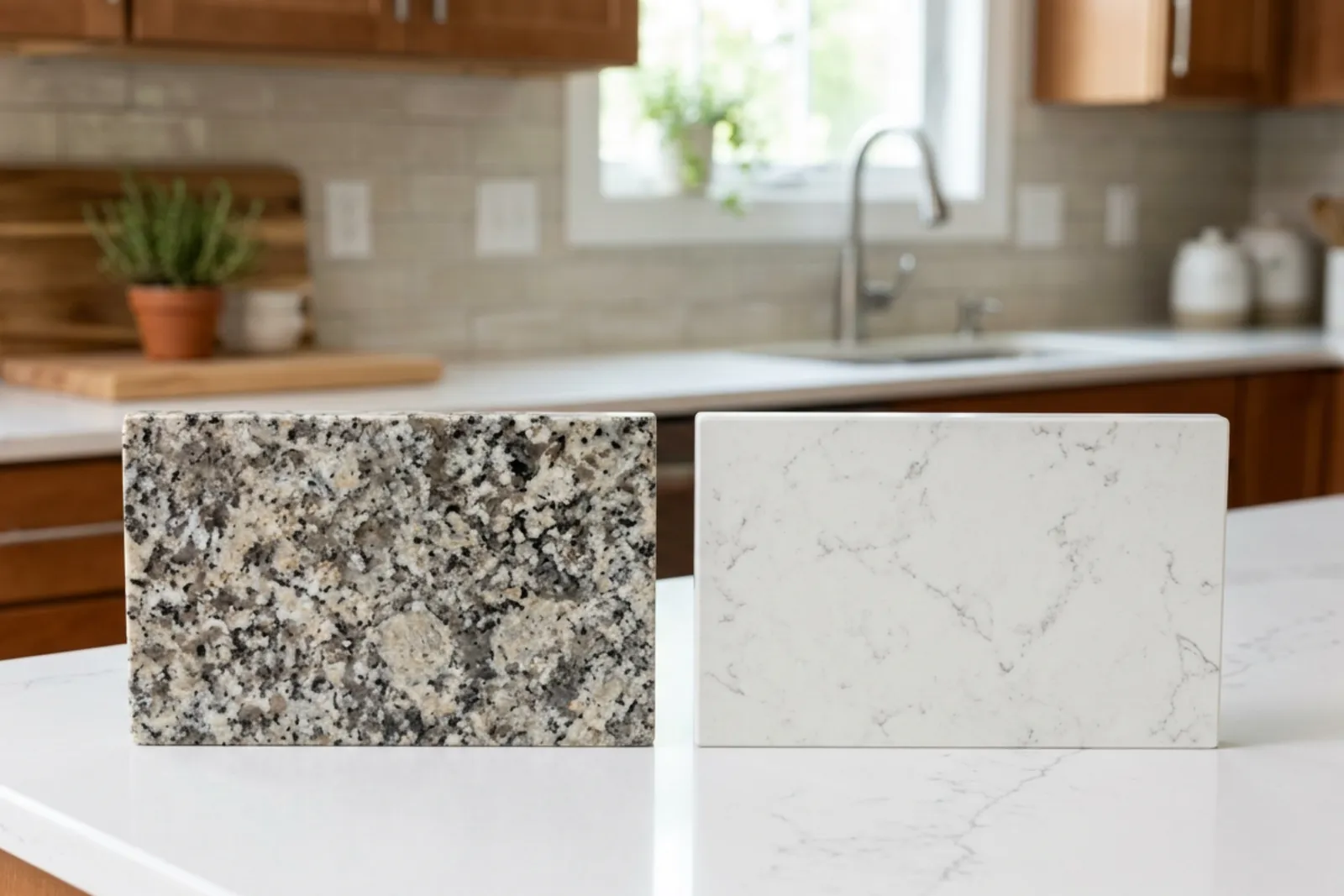
Quartz and granite often end up on the same kitchen renovation shortlist. Both are durable, both can work with a wide range of cabinet styles, and neither is a purchase you want to make twice.
The difficulty is that showroom samples tell you only part of the story. A small square cannot show where a seam will land, how an island will be supported, or whether a pale surface will suit your everyday cooking habits. Price comparisons can be equally confusing when one quote includes installation and another leaves out removal, plumbing, or edge finishing.
For homeowners in Vancouver, Burnaby, and the Lower Mainland, access and project coordination matter, too. Getting a large slab into a detached home is a different job from bringing it into a condo with elevator restrictions.
Here is how quartz and granite compare, and what to settle before requesting quotes.
What Is the Difference Between Quartz and Granite?
Quartz countertops are engineered surfaces made with mineral particles, including quartz, combined with binders and pigments. Formulations vary by manufacturer and product line. This manufacturing process allows for consistent colors, fine patterns, and designs that resemble natural stone.
Granite is natural stone cut into slabs, then finished and fabricated for installation. Every slab has its own mineral pattern. Products sold commercially as granite can also include related natural stones, so the exact slab’s properties matter more than the category name alone.
That distinction explains much of the choice.
With quartz, you generally get greater predictability and no routine sealing requirement. With granite, you get natural variation and generally better heat tolerance, but you may need periodic sealing.
Neither material is maintenance-free or damage-proof. The better choice depends on which compromises fit your household.
Appearance: Consistency or Natural Variation?
Quartz makes a coordinated design easier
Quartz is useful when you want a controlled palette. If your kitchen includes warm wood cabinets, a patterned floor, and a colorful backsplash, a quiet quartz surface can keep those materials from competing.
It is also available in dramatic veined patterns. However, a marble-look sample does not tell you how those veins will travel across a large island or meet at a seam.
Ask to see a full slab or an accurate slab image. For strongly patterned designs, request a fabrication layout before cutting. Veins may change direction at a corner, and a seam that is technically well executed can still be visually obvious.
Consistency has limits, too. Color and pattern can vary between production batches, so confirm that the material allocated to your project works together.
Granite makes the slab itself part of the decision
Granite can have fine, even speckling or broad areas of movement and contrast. Some slabs look restrained. Others become the strongest visual element in the room.
Choose the actual slabs whenever possible rather than approving only a sample. Two slabs sold under the same stone name may differ noticeably in color or pattern.
Look closely at natural fissures, resin-filled areas, and mineral changes with the fabricator. These are not automatically defects, but they deserve explanation. You should understand what you are buying before fabrication begins.
For either material, bring samples of your cabinet finish, flooring, and backsplash. View them together under lighting similar to your kitchen’s. Vancouver’s gray daylight and warm evening lighting can make the same white countertop look quite different.
Everyday Durability: What Can Each Surface Handle?
Quartz and granite are both hard, durable countertop materials. Still, hardness does not mean immunity to damage.
Scratches and chips
Both resist ordinary wear, but cutting boards are sensible on either surface. Cutting directly on stone can damage knives, and certain objects or abrasive materials can scratch the finish.
Edges and sink openings are more vulnerable to chips than the middle of a slab. A heavy pan striking a narrow edge can leave damage even when the surrounding surface looks untouched.
A slightly rounded edge may be more forgiving than a sharp square profile. That is worth discussing if your kitchen gets heavy use or includes a busy seating area.
Repairs are sometimes possible, but results depend on the material, pattern, and damage. A small filled chip may blend into a patterned granite slab more easily than a uniform quartz surface. There is no universal winner here.
Stains and spills
Quartz is generally nonporous and does not require sealing. That makes routine care straightforward, although it can still discolor or suffer surface damage from certain substances.
Granite’s absorbency varies. Some slabs absorb very little liquid; others benefit more from a suitable penetrating sealer. Sealing reduces absorption but does not make stone stain-proof.
Wipe up oil, wine, coffee, and strongly colored spills promptly on either surface. Ask for care instructions specific to the product you select rather than relying on general advice about “stone.”
Heat Resistance: Granite Has the Advantage, With Limits
If you regularly move hot cookware around the kitchen, this difference deserves attention.
Granite generally tolerates heat better than quartz. Quartz contains binders that can discolor or become damaged when exposed to high temperatures. Hot pans and heat-generating appliances can be a problem, particularly with prolonged or concentrated exposure.
Granite is not immune to heat damage. Rapid temperature changes can cause thermal stress, and sealers or repaired areas may react differently from the stone itself.
Use trivets with both materials. Follow the countertop manufacturer’s guidance for air fryers, slow cookers, and other appliances that release heat toward the surface.
A useful rule is simple: choose granite if heat tolerance is a major priority, but do not treat that advantage as permission to skip protection.
Maintenance: How Much Attention Is Realistic?
Quartz usually has the simpler routine. Mild soap, water, and a soft cloth are enough for everyday cleaning. Avoid abrasive pads and harsh chemicals unless the manufacturer specifically approves them.
Granite needs similarly gentle cleaning, plus an assessment of whether sealing is necessary. There is no reliable blanket schedule for every granite countertop. The stone’s absorbency, the sealer used, cleaning habits, and daily wear all affect the interval.
Ask your fabricator how to check the selected stone and which product to use. Do not assume that more frequent sealing is always better.
Finishes also change the experience. Honed or textured surfaces can show fingerprints, oil marks, or cleaning residue differently from polished finishes. If you are considering one, ask to see a working display and discuss its care requirements.
Neither surface should be described as automatically sanitary. Normal food-safety habits, including cleaning after handling raw ingredients, still apply.
Cost in Vancouver: Compare the Installed Scope
Quartz is not always cheaper than granite, and granite is not always the premium option. Their price ranges overlap. A readily available granite may cost less than a designer quartz, while an unusual natural slab can cost considerably more.
A square-foot rate alone is a weak basis for choosing.
The installed price depends on the selected material, slab yield, edge profile, sink cutouts, seams, backsplash work, and access. A large island may require an additional slab even when the total countertop area seems modest. Waterfall ends add material, fabrication, and installation work.
In the Lower Mainland, logistics can affect the quote. Condo elevator dimensions, loading access, parking, stairs, and building work-hour rules may change how an installer plans the job.
Ask each company to quote the same scope:
The exact material, finish, thickness, and edge profile.
Fabrication, delivery, installation, seams, and cutouts.
Removal and disposal of existing countertops, if required.
Support work, plumbing responsibilities, taxes, and any access charges.
These details make quotes comparable. A lower total may simply leave more work for someone else.
Cabinet Design and Countertops Need to Be Planned Together
The countertop should not be treated as a finishing touch that can be decided independently of the cabinets.
Both quartz and granite are heavy, and both need sound, properly supported cabinetry. Before templating, the base cabinets should be installed, secured, and level to the fabricator’s requirements.
If you are keeping existing cabinets, have them assessed. A new stone surface will not correct weak cabinet boxes, uneven runs, or inadequate support around an appliance opening.
Your cabinet maker and countertop fabricator should agree on island overhangs, support brackets, sink placement, and clearances. Unsupported spans depend on the material, thickness, cutouts, and manufacturer or engineering requirements. Generic overhang rules are not enough.
Cabinet design also affects how the finished counter top feels to use. Consider seating knee space, countertop height, dishwasher clearance, and access around the sink. A thicker-looking edge may be built up rather than solid throughout, which can change how it meets drawers and doors.
Resolve those details before fabrication. Stone is expensive to modify after cutting.
Vancouver Renovation Details Worth Checking Early
Local planning requirements do not change the basic properties of quartz or granite, but they can change the installation experience.
For a strata property, confirm renovation procedures before scheduling work. Your building may require approval, insurance documentation, elevator protection, or specific delivery hours. Ask the installer to check whether the proposed slab sections can reach the unit.
Measure access carefully for oversized islands. A slab that fits the kitchen layout may not fit through the route into the building. That can affect seam placement or make a different design necessary.
Keep the work sequence realistic. Final measurements usually happen after the cabinets are ready, and fabrication follows those measurements. Ask how the sink, faucet, cooktop, and plumbing connections will be coordinated. A countertop installation date does not necessarily mean the kitchen will be fully usable that evening.
Fabrication also creates hazardous respirable crystalline silica dust. Both materials require appropriate professional controls. Cutting or grinding should never be treated as a casual DIY adjustment, especially inside an occupied home.
Which Material Fits Your Kitchen?
Choose quartz if your priority is predictable appearance, straightforward maintenance, and a surface that does not need sealing. It is often a practical fit for homeowners who want a calm, coordinated kitchen and are comfortable being careful with heat.
Choose granite if you value natural variation and greater heat tolerance, and you are willing to follow the care requirements of the particular stone. It suits homeowners who enjoy choosing an individual slab rather than a repeatable manufactured pattern.
For an outdoor kitchen, check suitability separately. Many standard quartz products are not approved for outdoor use because sunlight and weather can affect them. Granite may be suitable, but the stone, supports, adhesives, and installation details must all suit exterior conditions.
Before committing, answer a few honest questions: Will you wipe up spills promptly? Do hot pans routinely land wherever there is space? Will a visible seam bother you? Are you choosing a pattern you enjoy, or one you feel you should like?
Those answers are more useful than a blanket claim that one material is “best.”
Make the Decision With a Slab and a Complete Quote
The strongest countertop choice combines a material you like with a fabrication plan you understand.
See the full slab. Review seams and edges. Confirm how the countertop will be supported and how it will reach your kitchen. Then compare written quotes that cover the same work.
Quartz often wins on consistency and ease of care. Granite often wins on natural character and heat tolerance. Either can work well in a Vancouver kitchen when the material, cabinet design, and installation details are considered together.