
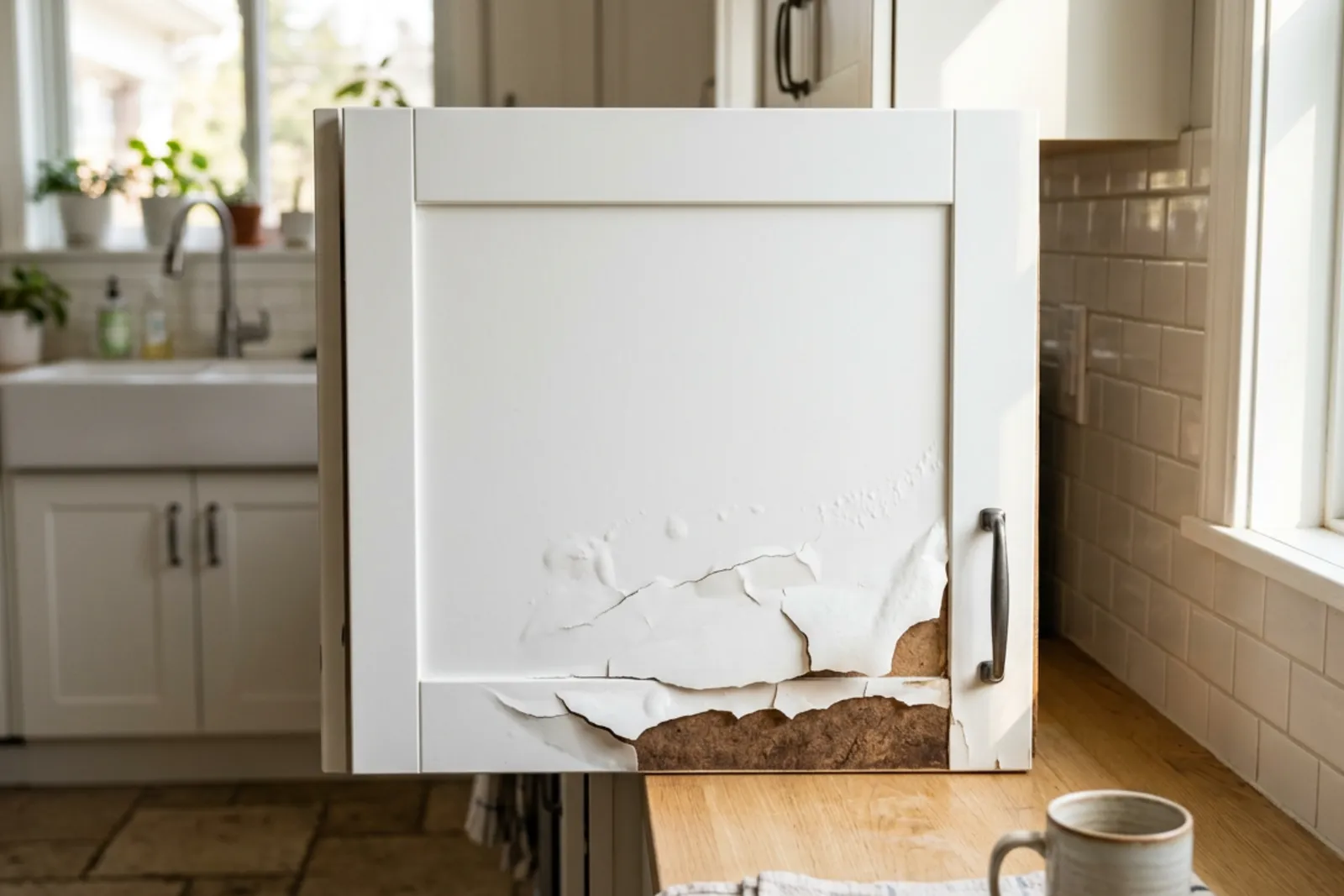
Two cabinet doors can look almost identical in a showroom and behave quite differently in a busy kitchen. A smooth white door might have a molded plastic covering, or it might be MDF finished with paint. That difference matters when the door sits beside an oven, gets splashed at a bathroom sink, or needs a repair years later.
Thermofoil and painted MDF both provide a consistent appearance without visible wood grain. Both can work well in kitchens and bathrooms. Neither is automatically the better choice.
The useful comparison starts beneath the finish, then moves to the conditions the doors will face. Heat, moisture, construction quality, and repair expectations deserve just as much attention as color.
What Is the Difference Between Thermofoil and Painted MDF?
MDF, or medium-density fiberboard, is an engineered panel made from wood fibers and adhesive pressed into dense sheets. Its uniform texture makes it suitable for smooth cabinet doors and routed profiles.
Unlike solid wood, MDF has no knots or grain patterns that can show through a painted finish. It also responds more uniformly to changes in indoor humidity, although it still expands and contracts and can swell when exposed to water.
Thermofoil and paint are two different ways to finish this substrate.
How thermofoil doors are made
Thermofoil is a plastic film, commonly vinyl, formed over a shaped core using heat, vacuum pressure, and adhesive. The core is often MDF. The film follows the door’s face and contours, creating a continuous-looking finished surface.
Despite its name, thermofoil is not a metal covering. The manufacturing process uses heat to shape the material, but that does not mean the finished door tolerates excessive heat in service.
The door’s back may have a different surface treatment. How the covering terminates at the edges and back matters because those areas can become vulnerable if the film lifts or water reaches the core.
How painted MDF doors are made
Painted MDF doors receive a coating system rather than a wrapped plastic film. Production typically involves surface preparation, primer, sanding, and finish coats. The exact process varies by manufacturer and coating type.
Preparation is especially important on routed areas and edges, which can absorb finish differently than the flat face. A well-prepared door should look consistent across both.
Available finishes include low-sheen, satin, and higher-gloss options. Glazes and specialized polyurethane systems can create other effects. However, the word “painted” alone tells you little about durability. The coating specification and application process matter.
Moisture Resistance: Look Beyond the Front Surface
Thermofoil’s plastic face resists everyday splashes and is generally easy to wipe dry. That makes it a practical option for bathrooms and other rooms where occasional moisture is expected.
But a moisture-resistant surface does not make the entire door waterproof.
Water can still cause problems if it reaches an exposed core, a damaged edge, or an opening around hardware. Persistent dampness is different from a splash that is promptly wiped away. Once MDF absorbs enough water to swell, drying it does not reliably restore its original dimensions.
Painted MDF also depends on an intact finish to protect the substrate. A properly specified coating can handle normal indoor use, but chips, worn edges, and poorly sealed areas give moisture a route into the board.
Match the door to the actual exposure
A bathroom with effective ventilation and occasional sink splashes presents different conditions than a small room where condensation remains on surfaces after every shower.
The same distinction applies in kitchens. A door beside a sink may be repeatedly touched with wet hands. Another may sit near a dishwasher that releases warm vapor. Those locations deserve closer attention than a dry storage cabinet across the room.
Good cabinet design accounts for these differences. Door finishes, ventilation, appliance placement, and countertop overhangs all influence exposure, though none replaces the need to wipe up standing water.
For either finish, the practical goal is simple: keep the protective surface intact and avoid prolonged wetting.
Heat Is a Major Consideration for Thermofoil
Heat deserves particular attention when choosing thermofoil doors. Excessive exposure can soften or weaken the bond between the plastic covering and its core. The result may be lifting, bubbling, peeling, or discoloration.
Potential trouble spots include cabinetry close to ovens and areas where small appliances direct heat or steam toward a door. A kettle used beneath a wall cabinet, for example, can repeatedly expose the same edge to concentrated vapor.
This does not mean thermofoil cannot be used in a kitchen. It means appliance clearances and installation details must be checked before the doors are ordered.
Metal heat shields or protective strips may be appropriate between certain appliances and nearby cabinetry. Their placement should follow the cabinet and appliance manufacturers’ requirements. A shield is not a substitute for required clearance.
Painted MDF avoids the specific problem of a plastic film separating from its core. Still, paint is not immune to heat. Depending on the coating and exposure, it may discolor, soften, crack, or lose adhesion.
Ask a cabinet maker to review the actual appliance layout rather than approve a finish in general terms. A door several feet from an oven faces different conditions than one immediately beside it.
Peeling, Cracking, and What Repairs Involve
Damage becomes more frustrating when the repair options are limited. Understanding how each finish can fail helps set realistic expectations.
Thermofoil damage can be difficult to repair invisibly
When thermofoil starts to peel, reattaching the loose section may appear straightforward. In practice, a lasting repair can be difficult if the film has shrunk, the adhesive has deteriorated, or the core has been damaged.
A repair may also leave visible edges or an uneven surface. Replacement is sometimes the more dependable solution for a badly affected door.
Before choosing thermofoil, ask how replacement doors are handled. Matching an older color or finish may become difficult if the original material is discontinued or surrounding doors change appearance over time.
Painted MDF can be refinished, but touch-ups have limits
Small paint chips may be repairable, depending on their location and the coating system. Larger damage may require filling, sanding, priming, and repainting the entire door to achieve an even appearance.
An exact spot repair is not guaranteed. Sheen differences can remain visible even when the color is close, particularly under strong side lighting.
Painted MDF offers a possible refinishing route that does not depend on restoring a molded film. However, water-swollen or badly fractured MDF may still require replacement. Paint cannot correct a structurally damaged core.
Door construction affects paint cracking
A traditional five-piece solid-wood door has separate frame and panel components. As those components move with humidity changes, fine cracks can appear in the paint at their joints.
A one-piece MDF door can have a recessed-panel profile routed directly into the board. With no separate frame joints on the face, it reduces that particular source of hairline cracking.
Not every MDF door is one piece, though. Some use multi-part construction. Ask how the door is built rather than assuming all painted MDF doors behave the same way.
Everyday Cleaning and Care
Thermofoil is often chosen for its wipe-clean convenience. Its smooth surface generally handles routine kitchen residue without needing wood-specific polishing products.
Painted doors can also be straightforward to maintain, but their resistance to grease, marks, and cleaning products depends on the coating. Sheen alone is not a reliable durability rating. A carefully formulated low-sheen cabinet finish may perform differently than an ordinary wall paint with a similar appearance.
For both options, start with the manufacturer’s care instructions. A soft cloth, a mild approved cleaner, and prompt drying are usually sensible basics. Avoid abrasive pads, aggressive solvents, and repeated scrubbing unless the manufacturer specifically permits them.
Applying cleaner to the cloth rather than soaking the door helps limit liquid around edges and hardware openings. Steam cleaners are a poor default choice because they combine heat with concentrated moisture.
Hardware can help, too. Handles that provide enough finger clearance reduce repeated contact with the finish. That is useful around frequently opened waste-bin cabinets and sink doors, where hands may be wet or greasy.
Appearance, Sheen, and Cabinet Design
Both finishes can produce a uniform look, but the available colors, textures, and profiles depend on the supplier.
Thermofoil is available in solid colors, wood-look patterns, and different surface textures. It can create a consistent appearance across many doors without the natural variation found in solid wood.
Painted MDF is useful when a smooth, grain-free finish is the priority. Depending on the finishing service, it may also allow more flexibility in color selection and decorative treatments.
Neither material should be judged from a tiny color chip alone. A full-size sample reveals how the finish behaves around routed edges, corners, and recessed areas.
High gloss needs closer inspection
High-gloss doors reflect light strongly. That can suit a clean, contemporary interior, but reflections also make surface waviness, dust, fingerprints, and application defects easier to see.
A uniform high-gloss painted finish can require substantial preparation and professional finishing work. The result depends on the entire process, not simply the final coat.
Lower-sheen finishes reflect less light, but they have their own trade-offs. Some show oily fingerprints or develop polished-looking patches where they are repeatedly rubbed. Compare real samples and ask how each finish should be cleaned.
View samples vertically in the room where they will be installed. Morning daylight and evening task lighting may reveal different qualities. Place them beside the countertop, flooring, and backsplash so the finish is assessed as part of the room rather than in isolation.
Questions to Ask Before Ordering Cabinet Doors
A useful discussion goes beyond “Which one lasts longer?” Service life depends on the product, installation, and household conditions.
Bring the layout and appliance specifications to your supplier, then ask:
What is the door core, and is the door one piece or assembled from separate components?
How are the back, edges, and hardware openings protected?
What clearances or heat shields are required near appliances?
Which coating or thermofoil product is being supplied, and what cleaning instructions apply?
What repair, refinishing, or replacement options are available if a door is damaged?
Written product information is more useful than a broad assurance that a finish is “durable.” It gives you something specific to evaluate and follow after installation.
Choosing for the Room You Actually Use
Thermofoil can be a sensible choice when easy cleaning and a consistent factory-finished appearance are priorities, provided heat exposure is controlled and vulnerable areas stay protected.
Painted MDF may be preferable when color flexibility, a grain-free surface, and the possibility of future refinishing matter more. One-piece construction can also reduce joint-related paint cracking compared with conventional framed solid-wood doors.
The deciding factor is often the location rather than the overall style. A dry storage area, a busy sink cabinet, and a door beside an oven do not face the same demands.
Choose the finish with those conditions in mind. Then support it with sound installation, suitable ventilation, and ordinary care. Those practical details often have more influence on long-term appearance than the finish name on the sample.