
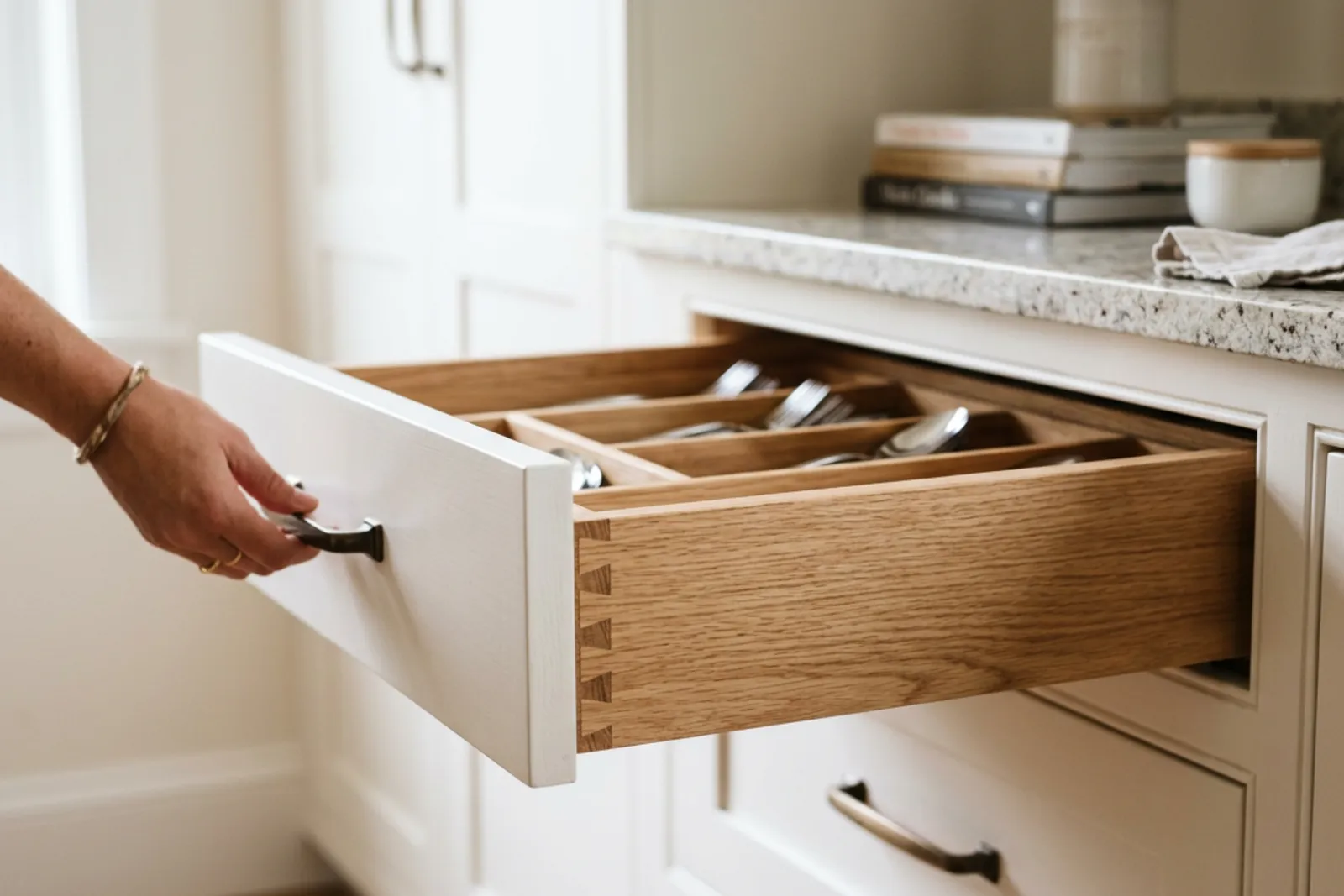
Two cabinet quotes can describe kitchens that look almost identical and still come back thousands of dollars apart. That difference can be frustrating, especially when both proposals promise “quality cabinets” without explaining what that means.
The price is usually hidden in details that photographs do not show: cabinet box construction, drawer hardware, finishing methods, installation work, and how much customization the room needs.
A useful comparison starts with specifications, not the bottom line. Once you understand what each cabinet maker has included, you can decide which costs support durability and daily use, and which are optional design choices.
Start With the Cabinet Category
Stock, semi-custom, and custom cabinetry follow different production methods. Those differences affect price, fit, and delivery time.
Stock cabinets come in predetermined sizes, often in 3-inch increments. They generally cost less because manufacturers produce standardized units in volume. Ready-to-assemble cabinets require assembly, which may be charged separately or included in installation.
Semi-custom cabinets start with an established product system but allow more choices in sizing, finishes, and interior configurations. Some manufacturers offer width adjustments in 1-inch increments; others use different sizing rules.
Fully custom cabinets are built around project-specific dimensions and details. That flexibility is useful for unusual layouts, but it requires more design, fabrication, and installation labor.
The following figures are broad Canadian-dollar planning ranges, not fixed market prices:
Cabinet categoryApproximate cost per linear footIllustrative cabinet package totalStock or ready-to-assemble$100 to $300$3,000 to $10,000Semi-custom$300 to $750$8,000 to $30,000Lower-priced custom$500 to $800$15,000 to $25,000Midrange custom$800 to $1,200$25,000 to $45,000High-end custom$1,200 to $1,500 or more$45,000 to $100,000 or more
Installation assumptions vary, so confirm whether each quoted rate includes assembly, delivery, and installation. Package totals also depend on kitchen size and configuration; they are not direct conversions of the linear-foot figures.
Linear-foot pricing is especially easy to misread. One supplier may assume a basic combination of upper and lower cabinets, while another prices them separately. Islands, tall pantry units, finished panels, and drawer-heavy layouts can make that shortcut unreliable.
Use these ranges to establish a starting budget. Use drawings and written specifications to compare actual bids.
Cabinet Boxes: The Part You Rarely See
Doors get most of the attention. Cabinet boxes carry the load.
A quote that says only “wood cabinets” leaves too much unanswered. Ask for the box material, panel thickness, back construction, and exposed-edge treatment. Shelf construction and installation details matter, too.
Plywood, particleboard, and MDF
Plywood has cross-laminated layers that generally provide good dimensional stability and screw-holding strength. It is a common choice for durable cabinet boxes, although grade, thickness, and manufacturing quality vary.
Particleboard can be economical and perform adequately in dry conditions. Its weakness is water exposure, particularly at unprotected edges or around fasteners. A slow leak beneath a sink can cause swelling that is difficult to repair.
Medium-density fiberboard, or MDF, needs a more careful discussion. MDF door fronts and MDF cabinet boxes are different specifications. MDF is often well suited to painted doors because its smooth surface does not have grain that can show through the finish. Standard MDF used in moisture-prone locations needs appropriate protection.
No wood-based cabinet material is waterproof. Even a plywood sink cabinet needs prompt leak repairs and sensible moisture protection.
Veneer is not automatically a compromise
Veneer is a thin layer of real wood bonded to a substrate. Well-made veneered panels can provide attractive grain consistency and dimensional stability.
The useful questions concern the substrate, veneer quality, edge treatment, and finish. A photograph cannot answer them. Two walnut-front kitchens may look similar while using very different box materials and construction methods.
Door Materials and Finishes Change the Price
Cabinet design affects cost through both appearance and manufacturing effort. A simple flat door usually requires less machining than a detailed door, but premium veneer selection or a demanding finish can reverse that comparison.
Hard maple has a fine grain and is commonly used for painted doors and traditional joinery. Painted MDF doors may cost less and provide a particularly smooth surface. Solid-wood door frames can develop small seasonal movement lines at joints, even when properly made.
White oak is popular for visible-grain finishes. Rift-sawn material is selected for a relatively straight grain and often carries a premium because of processing yield and selection. Quarter-sawn oak has a different grain appearance, including visible ray patterns, and can also command higher prices.
Walnut usually adds material cost, while cherry is valued for its warm appearance and the color changes that develop with age.
Finish specifications deserve their own discussion. Ask what coating system is included, how samples are approved, and whether the price covers finished ends, trim, and touch-ups. A custom color match or carefully coordinated veneer pattern involves labor that “painted cabinets” does not adequately describe.
Hardware and Storage Can Quietly Increase a Quote
Two kitchens with the same number of cabinet fronts may have very different hardware costs.
A basic base cabinet with doors needs hinges and shelves. A drawer cabinet needs drawer boxes, slides, and more assembly. Deep drawers often make cookware easier to reach, but that convenience increases the initial price.
Ask for hardware brands and product models rather than accepting “premium soft-close” as a complete specification. Load ratings, extension length, adjustment options, and replacement availability are more useful than broad quality labels.
Interior accessories can also add up. Pull-out waste systems, corner mechanisms, pantry fittings, and drawer organizers each add material and installation costs.
Spend where the benefit is clear. Someone who cooks daily may get more value from dependable full-extension drawers than from an elaborate corner fitting that is awkward to use.
Why the Room Itself Affects Cabinet Pricing
A cabinet package cannot be priced accurately without considering the space it must fit.
An older home may have walls that lean, floors that slope, or corners that are not square. Installers may need to scribe fillers or panels, trimming them to follow the surrounding surface. That work takes time and skill.
Custom construction can help accommodate difficult conditions, but an older home does not automatically require fully custom cabinets. Well-planned semi-custom units with suitable fillers may work. The decision depends on measurements and the desired result.
Ceiling-height cabinetry adds storage and removes the open gap above upper cabinets. It also requires more material and can make installation harder when the ceiling is uneven.
Metro Vancouver projects need local pricing rather than a national budget assumption. Shop space, skilled labor, transportation, and building access can affect costs. Condo elevator reservations, loading restrictions, and limited delivery windows may add coordination work even when the cabinets themselves are straightforward.
Labor Includes Much More Than Installation
A custom cabinet quote may cover site measurement, design revisions, shop drawings, material ordering, fabrication, finishing, delivery, and installation.
That is a substantial amount of work before the first cabinet reaches the home.
A preliminary measure can support planning, but final fabrication dimensions should reflect the agreed finished conditions. Depending on the project, that may mean waiting until drywall or other relevant surfaces are complete.
Typical planning allowances might include two to four weeks for design and measurement, followed by eight to sixteen weeks for custom fabrication and one to two weeks for installation. Semi-custom production may take roughly four to eight weeks. Actual schedules depend on shop capacity, materials, project size, and site readiness.
Flooring requires coordination rather than a blanket rule. Some flooring belongs beneath cabinets; some floating-floor systems must remain free to move and should not be pinned down by fixed cabinetry. Follow the flooring manufacturer's requirements.
Cabinets also need to be installed, secured, and level before countertop templating. A delay in cabinet installation can therefore delay the countertop and later plumbing connections.
Changes after drawing approval may require replacement materials or revised fabrication. Ask how change orders are priced and how they affect the schedule before approving production.
Separate Cabinet Costs From the Rest of the Renovation
Cabinetry can consume roughly 30% to 40% of a kitchen renovation budget, but that proportion varies considerably. Extensive structural work or expensive appliances can change the balance.
A cabinet-only quote generally should not be assumed to include countertops, plumbing, electrical work, appliances, permits, or repairs behind the old cabinets.
For example, moving a sink changes more than cabinet design. It may require plumbing alterations, electrical coordination, and permit review. A wall-mounted vanity may need reinforcement inside the wall, which is separate from building the vanity.
Secondary millwork can also distort comparisons. A proposal that includes a bathroom vanity or home-office built-ins should not be compared directly with a kitchen-only bid.
Renovation surprises deserve a separate contingency. Rot, damaged subfloors, or outdated wiring may become visible only after demolition. Ask how concealed conditions will be documented and approved before extra work begins.
A Practical Method for Comparing Quotes
Give every bidder the same drawings and requirements wherever possible. Then compare the proposals using a short checklist:
Confirm cabinet quantities, dimensions, heights, drawer configurations, and finished panels.
Match box materials and thicknesses, door construction, wood species, and finishes.
Check hardware models, interior accessories, and specialty storage.
Identify whether measurement, delivery, installation, removal, scribing, and trim are included.
Record exclusions, taxes, allowances, payment terms, and change-order rules.
When something is missing, request clarification in writing. An allowance is not the same as a fixed price, and “installation included” may not cover demolition or wall repairs.
Imagine one quote is $24,000 and another is $29,000. The higher proposal includes plywood boxes, several deep drawer stacks, finished end panels, and installation. The lower proposal includes fewer drawers and excludes delivery and decorative panels.
Those prices do not yet describe the same purchase. Once the scopes match, the apparent gap may narrow, disappear, or become easier to justify.
Review the Contract and Payment Schedule
A detailed contract should carry the agreed specifications into the final agreement. Approved drawings, finish samples, hardware selections, scope, exclusions, and a written change process all help prevent disputes.
Payments should relate to identifiable project milestones. Custom work often requires an initial payment because materials and fabrication are specific to the project, but the schedule should explain what each payment covers.
In British Columbia, the Builders Lien Act generally requires a 10% statutory holdback, with a holdback period typically lasting 55 days after the applicable statutory trigger. The trigger and obligations depend on the circumstances; “55 days after installation” is not a reliable substitute for project-specific advice. Confirm the requirements with a qualified legal professional.
Verify liability insurance and appropriate WorkSafeBC coverage or clearance as part of contractor review.
Choose Value Around How You Will Use the Kitchen
The least expensive quote may be appropriate for a straightforward space with modest requirements. Fully custom cabinetry may be worthwhile where dimensions, storage needs, or architectural details demand it.
Neither category guarantees value on its own.
Be cautious with rules that tie cabinet spending to a fixed percentage of a home's value. Property prices vary too much for that to replace a practical renovation budget.
Instead, prioritize sound construction, reliable hardware, useful storage, and installation that fits the room properly. Then decide what the chosen wood, finish, and decorative details are worth to you.
A good quote makes those decisions visible. You should be able to understand what you are buying, what remains outside the price, and why one option costs more than another.