
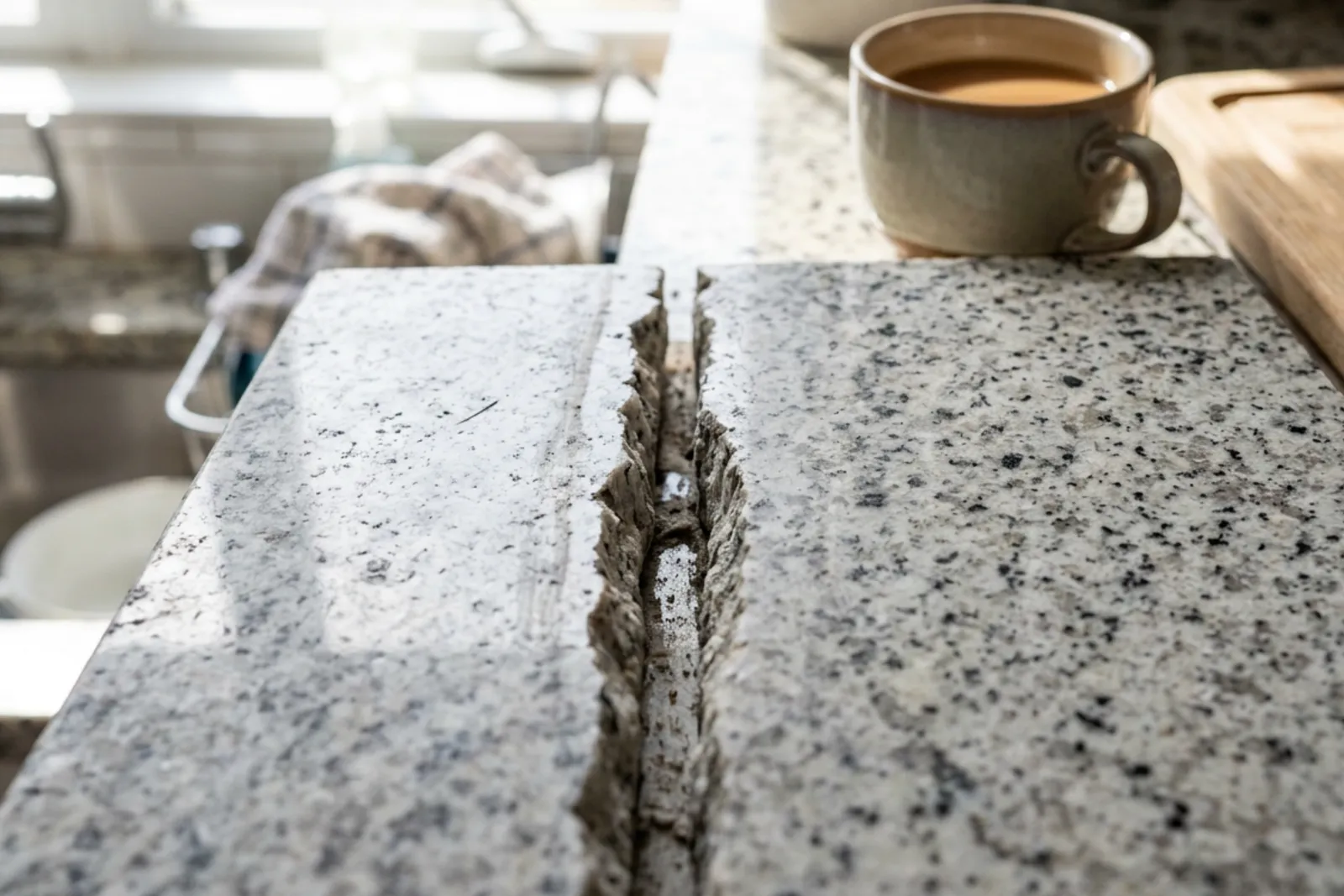
A countertop seam can look fine for years, then develop a dark line, a rough edge, or a gap that catches your fingernail. It is tempting to treat it as a simple filler problem. Sometimes it is. But an opening seam can also reveal movement in the cabinets, water damage beneath the surface, or a bond that never cured properly.
The lasting repair depends on what caused the joint to fail. Filling a gap without checking its support is a bit like repairing cracked drywall while the leak behind it continues.
Here is how to recognize different seam problems, understand their causes, and decide what needs attention before the joint is repaired.
Is It a Surface Gap or a Failed Seam?
Start by distinguishing the countertop joint from nearby caulk. Flexible caulk commonly seals the junction between a countertop and a wall or backsplash. The seam joining two countertop sections usually has a different adhesive and a different job.
A small split in backsplash caulk may be routine maintenance. A gap through the countertop joint, especially with a height difference between the pieces, needs closer assessment.
Check for these signs without forcing or loading the countertop:
A visible opening or a fingernail catching across the joint.
One side sitting higher than the other, often called lippage.
Discoloration, persistent dampness, or swelling beneath the seam.
Cracked backsplash grout or recurring separation nearby.
A gap that returns soon after being filled.
A straightedge laid gently across the seam can help reveal unevenness. Photographs taken over time can show whether the opening is changing.
A hollow sound when lightly tapping nearby may suggest a void, but it is not a reliable diagnosis by itself. Support arrangements and material thickness also affect sound. Avoid pressing hard on either side to test movement, particularly near a sink cutout or an already cracked section.
Why Countertop Seams Open
A seam depends on more than adhesive. The countertop, cabinets, supports, and building all behave as one assembly. Trouble often starts when those parts move differently.
Cabinet and support movement
Stone and engineered quartz are stiff. Wood-based cabinets and subtops can flex, swell, or shift beneath them. When adjacent countertop pieces move differently, stress concentrates at the joint.
An open span over a dishwasher, an inadequately supported corner, or cabinets that are not securely connected can contribute to failure. Concentrated loads make matters worse. Standing or sitting on a countertop can impose forces that ordinary kitchen use does not.
There is no universal safe unsupported span. Material thickness, slab characteristics, cutouts, reinforcement, and manufacturer requirements all matter. A span that works in one installation may be unsuitable in another.
Good cabinet design accounts for seam locations before fabrication. Wherever practical, joints should sit over cabinet walls or properly designed cross-supports. A cabinet maker and countertop fabricator should coordinate any brackets, rails, or subtops needed around appliance openings and other weak areas.
Poor adhesive bonding
Stone seams often use two-part adhesives, including epoxy, polyester, or acrylic systems selected for the material. Solid-surface countertops require their own compatible joint adhesives.
Even a suitable product can fail if the surfaces are damp, dusty, or contaminated with oil, sealer, or silicone residue. Incorrect mixing proportions can leave some adhesives soft or weak. Voids within the joint reduce the bonded area and concentrate stress.
Temperature matters during installation. Cold conditions can slow curing, while excessive heat can shorten working time. The product’s instructions should determine application temperature, mixing procedure, and cure time.
A wide or uneven gap is also harder to fill consistently. More adhesive does not correct poorly fitted edges or inadequate support.
Heat and repeated temperature changes
Countertop materials expand when heated and contract as they cool. The amount varies by material and product. Engineered quartz generally expands more than granite, although exact values differ.
Sunlight through a window, heat near cooking equipment, and appliance exhaust can create uneven temperatures across a counter. Repeated heating and cooling can stress a joint, especially where movement is restrained.
A hot pan introduces a more immediate risk. It can damage the surface or create localized thermal stress, so use a suitable trivet even when the material is described as heat resistant.
Flexible sealant may be appropriate at a designated movement joint or where the countertop meets another surface. It is not an automatic replacement for the structural adhesive in an ordinary slab seam. Changing the joint type requires a material-specific assessment.
Water damage underneath
Water entering an open seam can reach vulnerable cabinet components or a wood-based subtop. Particleboard is especially susceptible to swelling, and drying it rarely restores its original shape or strength.
That swelling can push the countertop upward or separate the joint further. A small opening then becomes a larger water-entry point.
Plywood can also swell or delaminate after prolonged exposure. The condition of the support matters more than whether its surface eventually feels dry.
Near sinks, inspect plumbing connections and the sink perimeter as well as the seam. Water may be reaching the cabinet through a leak somewhere else.
Building movement
Settlement or changes in the supporting floor can move one cabinet section relative to another. A countertop seam may open before the surrounding slab cracks.
Lippage combined with new wall cracks, sticking doors, or cracked backsplash tile deserves broader investigation. These signs do not prove foundation failure, but they should not be dismissed as an adhesive problem.
If movement appears ongoing, have the supporting structure assessed before repairing the seam. A qualified structural engineer may be needed when significant structural movement is suspected.
Why Seam Location and Material Matter
Seams near sinks need particular care. The cutout reduces the amount of material around the opening, people often lean against the front edge, and water exposure is frequent. Appliance openings create another challenge because continuous cabinet support may be absent.
Thickness also affects support requirements. A 2-centimeter slab generally needs different detailing than a 3-centimeter slab. Neither thickness guarantees a durable joint without suitable support.
Joint geometry matters, too, but a larger bonding surface alone does not solve movement. A mitered joint and a flat butt joint have different purposes and fabrication requirements. Both depend on accurate fitting and appropriate reinforcement.
Natural stone and engineered quartz
Granite, marble, and quartzite can all develop seam problems when support shifts or bonding fails. Their porosity, strength, and internal characteristics vary, even within the same stone category.
Some natural stone benefits from periodic sealing to reduce liquid absorption. Sealer does not glue a seam together, waterproof the cabinetry, or prevent structural movement.
Engineered quartz generally does not require penetrating sealer. Its seams still depend on compatible adhesive, careful fabrication, and proper support.
Laminate, solid surface, and wood
Laminate countertops are particularly vulnerable when water reaches the particleboard core. Once the core swells and lifts the laminate, applying seam filler over the top usually cannot restore a flat, sound joint.
Solid-surface seams use compatible adhesive and can often be repaired and refinished by a specialist. A visible line may result from a bonding defect, contamination, movement, or damage rather than simple filler shrinkage.
Butcher block behaves differently because wood changes dimension with moisture. Joint construction, fastening, finishing, and expansion allowance must accommodate that movement. A flexible sealant is not a substitute for a properly designed glued wood joint.
How a Cracked Countertop Seam Is Repaired
A sound repair follows the cause rather than starting with whatever filler matches the color.
1. Inspect the countertop and everything beneath it
The first step is checking the joint, cabinet connections, support rails, nearby cutouts, and evidence of moisture. The repairer should determine whether the adhesive alone failed or whether the pieces have shifted.
This inspection also establishes whether the existing edges can be reused. Chipped, contaminated, or poorly fitted edges may require more extensive work.
2. Correct movement or water damage
Loose or uneven cabinets may need adjustment and secure fastening. An unsupported span may require reinforcement designed for the countertop and cabinet assembly.
Brackets and rails must transfer loads into sound components. Screwing a support into a damaged particleboard edge is unlikely to provide a dependable repair.
Swollen or deteriorated substrate often needs replacement. Any plumbing leak or other moisture source should be corrected, and the assembly must dry sufficiently before bonding.
3. Prepare and realign the joint
For a failed bonded seam, a fabricator may remove the old adhesive, clean the edges, and bring the countertop sections back into alignment.
This is delicate work. Removing cured adhesive can chip stone, and moving a slab can damage sink connections or nearby surfaces. Professional seam-setting equipment helps control alignment and hold the pieces during curing.
Grinding down a raised edge without first understanding the movement can hide the symptom while leaving the cause untouched. It may also alter the surface finish.
4. Bond with the correct product
The repair adhesive must suit the countertop material and installation conditions. Color matching matters visually, but proper mixing, full contact, and curing matter to the bond.
Follow the specified cure time before loading, wetting, or using the repaired area. A joint that feels hard at the surface may not have reached its required strength.
Where a designed flexible joint is appropriate, use the specified sealant and joint dimensions. Smearing silicone over a failed structural seam is not equivalent to repairing it.
What Can You Safely Handle Yourself?
Replacing deteriorated caulk at a countertop-to-backsplash junction can be a reasonable maintenance task when the surfaces are stable and undamaged. Remove failed material carefully, clean and dry the area, and use a compatible sealant.
An opening between stone slabs is a different matter. Avoid pouring household epoxy, superglue, or general-purpose filler into it before assessment. These products can stain the edges or complicate later repairs.
If water is entering the gap, keep the area dry and arrange an inspection. Stop using a nearby leaking fixture. If the counter moves, has substantial lippage, or shows a crack extending into the slab, avoid loading that area.
Repair Costs and Expected Life
A straightforward in-place seam repair may cost a few hundred dollars. Recutting edges, moving slabs, disconnecting plumbing, or replacing damaged support can increase the cost substantially. Local labor rates and access also affect the estimate.
Ask whether the quoted work includes diagnosing support problems, preparing the joint, color matching, and repairing the underlying cause. A cheap refill that fails again is poor value.
There is no dependable expiration date for a countertop seam. A well-supported, correctly bonded joint can last for many years. Flexible caulk may need replacement sooner, depending on water exposure, cleaning products, and movement. Inspect its condition rather than relying only on a calendar.
Preventing Another Open Seam
Prevention begins before installation. Cabinet runs should be secure, coplanar, and supported according to the countertop manufacturer’s requirements. Seam placement should account for cutouts, appliance openings, and expected loads.
During fabrication and installation, accurate cuts, clean bonding surfaces, compatible adhesive, and controlled curing conditions all reduce the risk of failure. Afterward, keep water from lingering around joints, use trivets, and never stand on the counter.
Inspect seams when cleaning. A new dark line or slight height change is easier to investigate before water damages the support beneath it.
The central rule is simple: repair the reason the seam opened. When the cabinets are stable, the substrate is sound, and the joint is correctly bonded, the repair has a much better chance of lasting.