
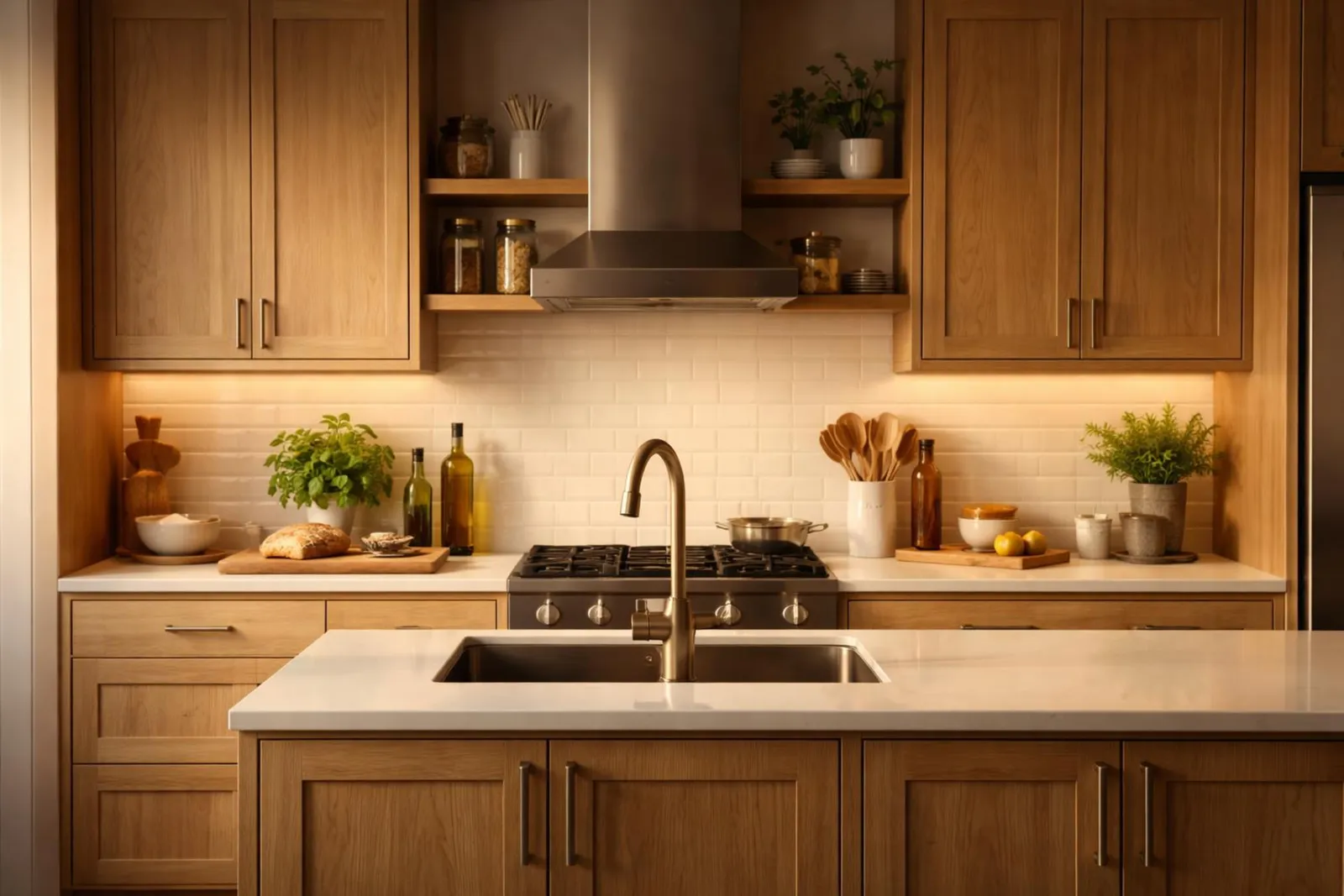
A kitchen can be technically functional and still feel annoying to use.
You know the type. Pots are stacked in the wrong place. Spice jars disappear into a dark upper cabinet. One drawer sticks. Another slams shut hard enough to make everyone look up. The doors are chipped, the finish is tired, and somehow even a simple weeknight dinner feels like more work than it should.
That frustration is often blamed on cooking itself. I don’t think that’s the real problem. More often, the kitchen is fighting back.
Modern wooden cabinets change that in a very practical way. Good cabinetry improves storage, shortens the time spent searching for things, reduces noise, and makes the room feel better to stand in. That last point matters more than people admit. If your kitchen feels calm and organized, cooking usually does too.
For homeowners planning a renovation, builders working on new construction, or anyone comparing cabinet design options with a cabinet maker, it helps to look beyond color and style. Cabinets affect workflow, mood, maintenance, and long-term value. They are not background scenery. They do real work every day.
Why Old Cabinets Make Cooking Feel Harder Than It Should
Most cabinet problems show up in small moments.
You reach for a frying pan and have to move three lids first. You open a lower cabinet and crouch down to find the olive oil hiding behind the slow cooker. You close a drawer and it bounces back. Nothing is dramatic, but the friction adds up.
Older cabinets often create problems in three areas.
1. Bad storage layout slows everything down
A kitchen works best when tools and ingredients are easy to see and easy to grab. Old layouts often do the opposite. Deep lower cupboards become black holes. Corner cabinets waste space. Narrow drawers hold too little. Upper cabinets force you to stack and restack items just to reach the one thing you need.
That affects the rhythm of cooking. Meal prep gets interrupted. Cleanup takes longer. Even packing lunches becomes a scavenger hunt.
2. Worn finishes change the feel of the room
People sometimes treat appearance as a bonus, but in a kitchen, appearance affects your daily experience. Chipped doors, peeling laminate, uneven gaps, and faded surfaces make the room feel neglected. That may sound cosmetic. It isn’t entirely. When a kitchen looks tired, it often feels harder to keep organized, and harder to enjoy.
I’ve noticed that people tolerate a lot in kitchens they describe as “fine.” Then they upgrade the cabinets and realize how much low-level irritation they had been carrying around.
3. Outdated cabinetry hurts resale appeal
Buyers notice kitchens quickly. They may forgive a wall color. They are less forgiving about cabinets that look old, flimsy, or poorly fitted. Even when buyers don’t plan to renovate right away, outdated cabinetry can make the whole home feel less cared for.
That matters in active housing markets like Burnaby and Coquitlam, where many owners think carefully about long-term value as well as day-to-day use.
What Modern Cabinets Actually Improve
“Modern” gets used loosely. Sometimes it only means a certain look. In practice, modern cabinetry is more useful when it describes better function.
The biggest improvements are not flashy. They are smart, simple, and noticeable every single day.
Storage That Works With the Way People Really Cook
The best modern cabinet design starts with a basic question: what do you use, and how often do you use it?
That sounds obvious, but it’s where many poor kitchens fall apart. Storage should match habits. Heavy cookware belongs where it can be lifted safely. Everyday dishes should sit close to the dishwasher or prep zone. Food storage containers should not require a full excavation to find a lid.
Deep drawers beat low cupboards for many items
Deep drawers are one of the most useful upgrades in modern kitchens. They work especially well for pots, pans, mixing bowls, small appliances, and even pantry goods.
Why? Because drawers bring contents out to you.
With a cupboard, you kneel and reach into the back. With a drawer, you pull and see everything at once. It sounds minor until you use it every day. Then it becomes hard to imagine going back.
Pull-out shelves reduce wasted space
Pull-out shelves solve a similar problem inside cabinets. They make it easier to access items stored at the back, especially in lower cabinets where visibility is poor. This is helpful for pantry staples, baking trays, cleaning supplies, and cookware that doesn’t fit well in standard shelving.
For clients talking with a cabinet maker about efficiency, pull-outs are often one of the smartest choices per dollar spent.
Corner storage can be made useful
Corner cabinets have frustrated people for decades. Modern systems improve that. Swing-out trays, pull-out corner solutions, and better interior planning help reclaim space that used to be awkward or forgotten.
No cabinet configuration is perfect, and corner solutions vary in cost and convenience, but a well-planned modern layout is far better than a blind corner that stores things you’ll never see again.
Wood Changes More Than the Look
There is a reason wood stays popular, even when other materials try to imitate it.
Wood has warmth. Real texture. Variation. It doesn’t feel flat or artificial. That matters in a room filled with hard surfaces like tile, stone, glass, and metal. Wooden cabinets soften the kitchen without making it look old-fashioned.
I think that balance is why so many people keep coming back to it.
Why natural wood feels better over time
Synthetics often look good when brand new and then age badly. They chip, peel, or fade in a way that feels abrupt. Wood tends to age with more character. It can show wear, yes, but good wood cabinetry often develops a lived-in quality rather than just looking damaged.
That makes it a strong long-term choice for both homes and projects intended to hold value over many years.
Common wood choices
Maple
Maple is durable, smooth-grained, and adaptable. It works well for lighter finishes and painted looks, though many people prefer to show the grain. If you want a clean, modern appearance without heavy texture, maple is often a safe choice.
Oak
Oak is strong and more visibly grained. Some people love that texture. Others find it too pronounced. In the right cabinet design, oak can feel current rather than dated, especially with simpler door profiles and less yellow-toned finishing than older kitchens used.
Walnut
Walnut is darker and usually chosen for a more dramatic or contemporary feel. It brings depth and warmth, and it pairs especially well with minimal hardware and simple lines. It usually sits at a higher price point, so it is often used selectively or in feature areas.
Quiet Cabinets Change the Mood of the Kitchen
This is one of those upgrades people underestimate until they live with it.
Soft-close drawers and hinges reduce noise in a way that makes the whole room feel calmer. No slamming. No rattling. Less wear on doors and drawer boxes. Less tension during rushed mornings or crowded evenings.
If you have children, shift workers, or an open-concept home, the value becomes even more obvious. A noisy kitchen spills into the rest of the house. A quieter one is simply easier to live with.
Soft-close hardware also helps cabinetry last longer because doors and drawers are not repeatedly forced shut at full impact. That kind of protection matters over years of daily use.
Good Cabinet Design Is About Workflow, Not Just Style
Style matters. Of course it does. But if a kitchen looks good and works poorly, people get tired of it fast.
Thoughtful cabinet design pays attention to movement. Where do you prep food? Where do you wash? Where do you store dishes? Where does the garbage go? How far do you have to walk to unload groceries or load the dishwasher?
A useful layout tries to reduce pointless motion.
For example:
prep tools should sit near the main work surface
dishes should be easy to reach from both dining and dishwasher zones
pantry storage should not block circulation
trash and recycling should be close to prep areas
heavy items should live below waist or chest height, not above your head
These are simple decisions, but they shape how cooking feels. When storage matches behavior, the kitchen gets out of your way.
That is one reason builders and renovators should involve cabinet planning early, especially when the cabinet layout also affects appliance placement, lighting, backsplash lines, and the counter top design. Cabinets and counters are deeply connected. The wrong cabinet dimensions can limit sink placement, reduce prep space, or create awkward seams in the counter top.
Modern Styles That Age Well
Trends come and go, and kitchens are expensive enough that most people do not want to chase every shift in taste.
The safest modern styles are usually the simplest ones.
Shaker doors
Shaker cabinetry remains popular because it is clean without feeling cold. It works in traditional homes, newer builds, and transitional spaces. It also gives wood a bit of structure without becoming overly ornate.
Flat-panel doors
Flat-panel doors lean more contemporary. They fit especially well in streamlined kitchens with minimal visual clutter. If you want a modern look that still lets natural wood grain show, flat-panel walnut or maple can work very well.
Minimal hardware
Simple pulls, integrated handles, or restrained knobs tend to age better than elaborate hardware. The goal is not to make cabinets invisible. It is to avoid details that lock the kitchen into one very specific moment in design history.
Natural finishes
Natural wood finishes continue to appeal because they feel honest. They also adapt well if the rest of the room changes later. Flooring, paint, lighting, and even the counter top can be updated without forcing a full cabinet replacement.
Why Professional Installation Matters More Than People Expect
A good cabinet can perform badly if it is installed badly.
This is where a lot can go wrong. Doors may look even at first glance but still hang slightly out of alignment. Drawers may rub. Cabinets may sit a little off-level, which affects reveals, hardware, and long-term wear. Counter top installation can also be compromised if the cabinet bases are not properly set.
Professional installation protects the investment in a few clear ways.
Accurate alignment
Level, square cabinets matter. They affect door gaps, drawer movement, appliance fit, and the final finish of the entire kitchen. In older homes, where floors and walls are rarely perfect, installation often requires careful adjustment that inexperienced installers miss.
Better function over time
Cabinets should not just look right on day one. They should still open smoothly years later. Proper fastening, correct spacing, and thoughtful hardware setup help prevent sagging, sticking, and premature wear.
Fewer costly mistakes
A professional installer understands how cabinet design interacts with plumbing, electrical locations, appliance clearances, and counter top templating. Catching problems early is much cheaper than fixing them after materials are cut or finished.
For new construction, this coordination matters because small measurement errors can ripple through the schedule. For renovations, it matters because existing spaces are rarely as straightforward as the plans suggest.
Durability, Long-Term Value, and Resale
Solid wood cabinetry is not cheap, and it shouldn’t be judged like a short-term purchase.
With proper care, solid wood cabinets can last 25 to 50 years or more. That kind of lifespan changes the math. You are not simply buying storage. You are buying a part of the house that should keep working through daily use, style changes, and life changes.
In markets such as Burnaby and Coquitlam, many property owners choose wood cabinetry because it balances function, timeless appearance, and resale appeal. Buyers tend to respond well to kitchens that feel substantial and well planned. They can usually tell the difference between cabinetry that was chosen for speed and cabinetry that was chosen to last.
That doesn’t mean every project needs the most expensive wood species or the most elaborate hardware package. It means quality in the right places matters. Solid construction, sensible layout, durable finishes, and professional installation usually matter more than decorative extras.
Questions People Usually Ask Before Choosing Wooden Cabinets
Are solid wood cabinets really durable enough for a busy kitchen?
Yes. With normal maintenance, solid wood cabinets can last decades. They handle everyday wear well, and many minor issues can be repaired instead of forcing full replacement.
What wood is best?
There is no single best option. Maple is versatile and durable. Oak is strong with visible grain. Walnut gives a darker, more contemporary look. The right choice depends on budget, style, and how much grain you want to see.
Are modern cabinets more useful than traditional ones?
Often, yes. The biggest difference is usually not the door style. It is the storage system. Deep drawers, pull-outs, better corner access, and soft-close hardware make day-to-day cooking easier.
Do new cabinets increase home value?
Quality cabinets generally improve home appeal and can support resale value, especially in kitchens where old cabinetry makes the room feel dated or poorly maintained.
The Real Payoff: Cooking Feels Less Like Friction
When people talk about kitchen upgrades, they sometimes focus too much on the dramatic before-and-after photo. I get it. Photos are easy to sell. Daily use is harder to capture.
But the real payoff of modern wooden cabinets is more ordinary than dramatic. You find what you need faster. The drawers move smoothly. The doors close quietly. The room feels warmer. Cleanup takes less effort. The kitchen stops interrupting you.
That is what better design should do.
If you are planning a renovation, starting a new build, or comparing options with a cabinet maker, it is worth paying attention to the details that affect life after the install. Good cabinet design is not only about appearance. It is about workflow, comfort, durability, and how the kitchen supports the people using it every day.
And yes, style matters. But the best kitchens earn their keep in the quiet moments, when dinner is half-prepped, the sink is full, and everything still feels easy enough to handle.